Find party invitations for any occasion at eInvite.com. Personalize, preview, and order your invitation instantly.
Showing posts with label Educational. Show all posts

Friday, June 5, 2009

Thing 155: The Notorious Scandals of Dupont Circle


The final tour I took over WalkingTown DC weekend was the Notorious Scandals of Dupont Circle tour. I was not the only person to have this idea. Over 200 people showed up for this tour which was...too many. Although the tour was still fun, it lost a good deal of its charm by virtue of having to do battle with other people in order to get close enough to hear our guide. Even with that obstacle though, I learned the following things:
  • In the late 1910s, an anarchist attempted to blow up a member of the Cabinet by strapping explosives to his body and then ringing the doorbell. Unfortunately, on his way up to the house to ring the door bell, the young man tripped on the sidewalk and blew himself up -- and what a powerful explosion it was! Paul, our guide, read us the newspaper account, which was mighty gruesome, including that the man's spinal column flew across the street, broke an upstairs window, and landed by the bed of a student trying to take a nap!
  • The Hope Diamond belonged to a woman who lived in Dupont Circle (the house that is now the Indonesian embassy, in fact) -- her family was so rich that seemed to have just bought it on a lark, and there are pictures of her swimming in it, and accounts that she would attach it to her dog's collar before taking him out for a stroll.

  • And speaking of diamonds, that lady from the Titanic movie? Rose? Based on a DC resident. She was way ahead of her time, writing and lecturing on how women should be their own people and make their own living. She lived on New Hampshire Avenue, and was coming back from Europe aboard the Titanic. When the Titanic hit the iceberg, she found a lifeboat that was being captained by a very inept male crew member -- she and another woman took it over and steered them towards rescue.

  • DC also has its own "Schindler" who saved a bunch of Jews during the war, but didn't get a movie made about him so isn't as famous. And of course, I didn't take notes during this tour, so I am unable to bring his name to light even now. But, if I recall, he saved 60,000 German Jews by getting them US visas in a hurry.

  • We stopped along the block of Q Street between 17th & 18th, right in front of a man's house who was just sitting on his front stoop, drinking coffee and reading the Sunday paper. Suddenly, 200 people swarm around his house, as our guide announces to us that this block is famous for murder and mayhem. In fact, in front of this particular house, a man was killed with nothing but a slingshot. Nice relaxing Sunday for that home owner, I imagine.

  • DC had its very own slasher -- like Jack the Ripper. This person would break into people's homes, and slash his victims ruthlessly. This went on on and off for six years until he was finally apprehended. How could this go on so long? His victims were sofas, and other pieces of furniture, and so he was pretty low on the police's priority list.

  • Dupont Circle originally had a statue of Admiral Dupont in the center of it -- just as Logan or Thomas or Scott circles have statues of Logan or Thomas or Scott. Except apparently, Admiral Dupont was a pretty terrible admiral. His statue was mocked when it stood in the circle, and eventually, his family took it down and moved it to the family estate, and commissioned the now-beloved fountain to stand in its place.


Our tour was led by Paul Williams of Historic Dupont Circle Main Streets, who literally wrote the book on Dupont Circle. He was as surprised as the rest of us by the sheer turnout for the tour, but stayed in good spirits and projected his voice just as much as he could. And he clearly took delight in all the scandals and murder that he told us about, as did the 200 of us listening, and the odd homeowner who might have learned a little something new about his home that day.

Thursday, June 4, 2009

Thing 154: Walking Tour of Brookland

Continuing with my recap of WalkingTown DC free walking tour weekend, I got off at the Brookland/CUA metro stop for a walking tour through the Brookland neighborhood. This was the second time getting off at that metro stop in the entire ten years I've lived here, and the first time was to go to a craft fair at Catholic University. So I was really going into this tour without any idea of what I might learn or see or find.

What I found is a highly residential, very diverse, suburban feeling neighborhood, with a mix of houses going back to the early 1900s up to modern architecture. Our guide, Ed, had lived in the neighborhood for seventeen years and was proud to show us the homes of any resident, past or president, who had even a tenuous claim to fame.

We started out tour by seeing the original Brooks mansion, which lent Brookland its name once the property was divided and sold. In the 1840s, the Queen family had built their daughter and her new husband, Mr. Brooks, a mansion on a hill, sitting on a hundred or so acres. In the 1880s, the land was partitioned and sold. Because it was not sold to a developer but rather sold as individual lots, there's no uniform look to the neighborhood -- everyone built whatever kind of house they wanted to. In addition, because the lots were sold individually, it was a more hospitable neighborhood for African Americans, and the neighborhood has a rich history of prominent African Americans as residents.


The neighborhood also has a rich Catholic history. Not only is Catholic University right across the train tracks, but there are numerous Catholic schools and churches in the neighborhood. In addition, there is a Franciscan monastery up the hill that is truly stunning.

Ed led us up the hill (past a park that used to be a Civil Was fort, but now apparently has really excellent sledding terrain in the winter) and once we'd entered the monastery, gave us ten minutes to explore on our own. The monastery is completely breathtaking.


Inside city limits, tucked away in the middle of a residential neighborhood, is a huge monastery, with a gorgeous rose garden, fountains, cloisters lined with vibrant mosaics, and the "Ave Maria" in every language of the world. That's all I had a chance to see in ten minutes, but I already have plans to go back and spend an afternoon there, so I will report back shortly on what else there is there. Ed said there were catacombs, which I'm looking forward to. But the fraction that I did see completely blew me away, and made the trip out to Brookland well worth it.

I do have a major remaining question about Brookland -- aside from frolicking through the monastery and gardening in your enormous corner lot, what is there to do there? We passed through their commercial strip, but it looked mostly like chains or takeout counters. What am I missing? If you have a favorite bar, restaurant, museum or activity in Brookland, leave it in the comments. I am intrigued by the neighborhood, but not sure what else might be there.

Two years ago: The smoky goodness that is Rocklands BBQ.

Wednesday, June 3, 2009

Thing 153: Walking Tour of Historic Logan Circle

I live in Logan Circle. I shop there, I eat there, I've worked there -- in other words, it's my home base. Which is why I'm so embarrassed that I knew virtually nothing of the history of the neighborhood! Did you know that General Logan started Memorial Day? Or that Logan Circle was originally called Iowa Circle? And that the Iowa Circle neighborhood was called "Hell's Bottom" in the late 1800s because it was that bad? Or that Mary McLeod Bethune used to live in the neighborhood? Next to a museum for confederate soldiers?

I learned so much on this tour.
We started the tour in Logan Circle itself, with our tour guide Tim, a small and good-humored man with the faintest of mohawks. He started by explaining to us how Iowa Circle fit into L'Enfant's grand plan for the capital, as one of the points of a triangle between Logan Circle, Dupont Circle and the White House. The circle was planned to be residential, and is now the only remaining purely residential circle in the whole city.

Almost from the get go, Iowa Circle was not a great neighborhood (hence the Hell's Bottom nickname), but then in 1968 it was pretty much burned to ground or otherwise destroyed in the riots following MLK Jr's assassination. After that, it's been on a slow but steady rebuild, that was greatly accelerated once Whole Foods opened up on P Street.

We walked from Logan Circle to Naylor Court, to learn a bit about residential alley life after the Civil War, and then contrasted that by looking at the SoLo Piazza building at the corner of 13th & N, as an example of the newer architecture in the neighborhood.

We learned that the Washington Plaza Hotel was designed by the same man who designed the Fontainebleau Hotel in Miami (and now that he mentioned it, I do see a strong resemblance), and across the street we learned about the rival Lutheran churches, as well as the history of the N Street Village.
Perhaps most interesting was just up the street from there, where the Mary McLeod Bethune House has been converted into a historic museum that gives tours! (It's on the list now, so keep an eye out for an upcoming Thing.) Apparently, when Mary McLeod Bethune was in DC, she lived in my neighborhood, out of the top floors of house on Vermont Ave, and on the bottom floor were the meeting places of the National Council of Negro Women. Then someone else on the tour group piped in that the enormous house two doors down from Mary McLeod Bethune's had been a rest home for Confederate veterans, and then was converted into a museum of Confederate history, which flew the Confederate flag! They must have made for uneasy neighbors.

We went down to the retail heart of Logan, P Street between 14th & 15th, where we got a peak at the original Shepard Fairey Obama portrait, and then stopped on 14th Street to talk about the Studio Theater, and the old Automobile Row of the 1950s. Have you ever wondered why so many buildings along 14th Street (like Posto, for example) have those enormous, open, first floors? They were automobile showrooms in the 1950s, and the buildings have all been deemed historic buildings since then, so they can't be redeveloped into less awkward spaces.

The tour ended back in Logan Circle, with the career of General Logan himself. General Logan was a staunch anti-abolitionist, until his experience fighting alongside black Union troops changed his mind and he became a strong advocate for civil rights. After the war, he was elected the Senator for Illinois, and had a townhouse actually on Iowa Circle, which would later be named for him. When he was re-elected to the Senate, several thousand black DC residents gathered in the circle to congratulate him, and he invited every single one of them into his home so he could have the honor of shaking their hand. Apparently, it took well into the night.

This is a brief (well, I tried to keep it brief) overview of the tour -- if you're interested in learning more about the neighborhood, I highly recommend taking the tour when WalkingTown DC comes back around next fall, or get in touch with the Logan Circle Community Association.

Coming up, I tour Brookland, and am way impressed by a neighborhood I knew nothing about!

Related: Bike tour of the Anacostia Riverwalk, Before There Was Harlem..., and North by Northwest.

Monday, June 1, 2009

Thing 152: Bike Tour of the Anacostia Riverwalk

If any of you out there are following my Twitter feed, you'll know I spent pretty much my entire weekend on one tour or another. Yes, it was the semiannual WalkingTown DC, which gives locals and tourists alike the opportunity to participate in over a hundred free walking and bike tours. This event is held in the spring and in the fall, and organized by Cultural Tourism DC, and I urge all of you to take advantage of this opportunity!

I started my WalkingTown weekend at 9am on Saturday morning at the entrance to the Southwest fish market, bike in tow. I was there for the bike tour of the Anacostia Riverwalk, along with about twenty other early birds. This tour is put on by the DC Department of Transportation (or DDoT, or "d.") and was actually led by the head of DDoT, Gabe Klein. Allow me a moment to geek out, but how cool is that? If you read this website, you'll remember that Gabe Klein was a bold and progressive choice for the job, having come off of a four year stint as regional VP of ZipCar, and as an advocate for transportation that might not necessarily begin and end with the personal car. And now here he was, in bike shorts and bright yellow biking shirt, ready to give the twenty of us his own guided tour of the Anacostia waterfront.

After giving us an introduction and an overview of the plan to rebuild the Southwest Waterfront area, we cycled in a pack down to the Titanic Memorial, and then east to the Nats Stadium. At the stadium, Klein, with help from three other DDoT employees, talked about the transportation issues surrounding the building of the stadium, and also the colossal engineering project that was the lowering of the South Capitol Street Bridge.

We continued on to the new USDoT, which stands next to the Navy Yard, and they spoke about the grand plan to connect the stadium all the way through the Navy Yard and beyond with new bike trails, hopefully easing some of the commuting congestion for the 20,000 expected new federal workers in the area. Klein mentioned that he's also looking at remaking the bridges, adding extra bus lines down M Street, and hopefully extending the upcoming street car system into the area, along with encouraging mixed-used developments so that people can live, work and play all within walking distance.

After this stop, I get a little hazy, geographically speaking, on where we went next. I know that we rode along a trail that took us next to a boat house where there were crew races:


And then over some railroad tracks and around and behind RFK Stadium, to what I think was Benning Road, where there was a farmers' market. We took a ten minute pause here to use restrooms and refuel, as needed.


From there, we crossed the Anacostia to its east bank, and then rode for several miles along the river, past a roller skating rink, past playgrounds and picnics and people fishing, seeing the crew races and the Navy Yard and the Stadium from an angle that I've never seen before. We met up again at Poplar Point, where one of the DDoT employees talked about the huge mixed-use development they envision some years into the future, with plenty of park land and new housing, retail and work space, all a few steps from the Anacostia Metro Station.

And from there, we went over the South Capitol Street bridge, and back to the fish market. In all, the ride took three hours, I saw parts of DC I've never seen before (and frankly, I'm not sure I can find again), and got an inside look at the vision behind a lot of the development projects that will shape the future of DC.

From there, I had to zip back home to shower and eat before heading to the next tour...Historic Logan Circle.

Related: Before There Was Harlem and North by Northwest

Monday, January 26, 2009

Thing 133: The National Museum of Health and Medicine


My grandparents had hoped my uncle would grow up to be a doctor. My grandfather was a doctor, and both of my grandmother's brothers as well as her father were doctors. So it was perhaps only natural that they would expect their only son to follow in the family business and heal the sick.

With these high hopes -- or so goes the family lore -- they paid a visit to a museum of medical oddities when my uncle was still a young and impressionable boy. My grandfather had hoped that the array of weird things floating in jars would pique the boy's interest. Instead, my uncle was so horrified by the entire experience that he swore he'd never become a doctor. He still recalls the experience with disgust and horror.

So it was with great excitement and not a small amount of trepidation that I agreed to visit the National Museum of Health and Medicine, located at Walter Reed Army Medical Center. I had heard that this museum had the bullet the killed Lincoln, fetuses in jars, and medical oddities of all kinds including the world's biggest hairball. I'm fairly squeamish, so while I was really intrigued, it wasn't out of the question that I might pass out on the premises.


Well, I remained conscious although there were a couple things that turned my stomach (especially the leprosy pictures and the leeches). Mostly though, the museum focuses on military medical history starting with the Civil War through the current conflict in Iraq. In particular, it chronicles the advances of caring for the war wounded, improvements in field hospitals and ways to identify those who died during war. There is also an extensive exhibit on the evolution of the microscope -- from Anton van Leeuwenhoek (hello seventh grade science!!) to modern electron microscopes.


But it's not all tame and historical. There is some weird, gross and even funny stuff in the collection too.

Take, for example, the world's biggest hairball. It was removed from the stomach of a 12 year old girl who had been eating her hair for six years and it was the exact shape of her stomach. Eww!


Or how about the preserved tongue and esophagus of someone who died while choking -- it's floating in formaldehyde along with the enormous piece of steak that the person died trying to eat.

Cross sections of lungs taken from coal miners (pitch black), iron minors (dark red), smokers (gray with white cancer) and city dwellers (distressingly, alarmingly nearly as gray as the smokers' lungs).


There was also an exhibit on misguided medical equipment, including an x-ray machine that x-ray'ed people's feet in their shoes at the shoe store to ensure that they fit properly. We watched a rather charming video about the machine in which we learned that these machines emitted 25 rems per minute in order to ensure that your shoes fit properly (recommended radiation exposure for nuclear power plant employees is not to exceed 5 rems per year!). About 20 years later, when shoe salesmen started dying of cancer left and right, the machines declined in popularity.


There is a lot to see at this museum -- it's free, and easily accessible from the 70 bus. You will need to show your ID in order to get onto the property though. If you like history, military history, science, medical facts or just really gross/weird stuff, you've got to go. I imagine that young boys might especially like this museum -- unless you're trying to initiate them into a medical career-- then it might backfire. Just ask my uncle.

Tuesday, January 13, 2009

Thing 129: Improv Workshop from WIT

"I am one of those people who believe that improv really changes who you are, and how you approach your life and relationships," Anna, our improv teacher for the night, told us by way of introduction.  What followed was two hours of games and exercises, as nine strangers stood in a circle to see where 'yes' would take us.

The Washington Improv Theater gives free workshops leading up to their regular sessions of classes, which cost $240 for eight weeks of 2 1/2 hour classes.  The free class is a great way to decide if you want to invest in the full session, if you've ever been curious but scared to commit to learning the fundamentals, or if you just want to flex your funny bone.  If you're shy or a ham, the small group setting and professional instruction will make you feel comfortable during what could be a pretty scary experience.

I was not in totally unfamiliar territory however.  Those of you who have read this blog very carefully, or who have just known me a long, long time, may recall that in high school I did my fair share of improv.  My high school theater program, which I remain grateful for even though I don't do a lick of theater in my adult life, really emphasized the skills of good improvising -- not just being funny, but being realistic, in the moment, accepting, open minded and empathetic.  Having gone through the introductory two hours with WIT, I am pleased to report back that they stress those same skills, valuing experience and truth over the cheap and easy laugh.

Anna led us through a series of games and exercises, some tried and true ('freeze tag,' 'what are you doing?') and others that I'd never done before ('emotional four square').  Throughout the lesson, she highlighted the 'teachable moments,' picking out the things that worked best in certain scenes, and explaining the theories or techniques behind why they worked.  We learned about mirroring of physicality and emotions, why patterns (and breaking them) are so darn funny, the importance of listening and accepting the realities as we created them on stage together.  She was a great teacher, knowledgeable, approachable, friendly and quick to encourage making mistakes as part of the learning process.

We were also fortunate that the group itself was eerily good at improvising off the bat.  Though by no means experts, we all worked together with the trust and openness of a troupe that knows each other intimately and has worked together a long time.

As part of my new year's resolutions to both save money and blog more, I will not signing up for the regular class session, but not because I didn't enjoy myself.  It felt really great to remove that safety net and take the leap, to not know what was coming next and accept it as it came.

Monday, July 21, 2008

Thing 119: Food Matters

Last weekend, the Boyfriend and I really classed things up by going to a wine tasting at Food Matters. Much like in the movie Sideways, we swirled and sniffed and sipped and declared some wines to be "fruity and bold" and others to be "crisp, light, with hints of citrus and petrol." This is much fancier than our usual Sunday night of laundry and Family Guy, so let me explain.

My coworker knows the owners of this establishment, or else I can't imagine it would have ended up on my radar. Owned by Tom and Christy Przystawik, two chefs who met and married while working in Jose Andres' kitchens, they were looking for a way out of the hectic life of professional kitchens and wanted a bit more freedom to pursue what they loved to do. Food Matters is the product of that love. It's a neighborhood stop, with a sit down menu, take out and prepared foods, a bar, and classes and tasting events. Its customers, several of whom we met at our tasting, seem very loyal to the place, and Food Matters is a true neighborhood meeting place.

It caught my eye when my coworker, on their mailing list, mentioned across the cubicle wall one day "Oh! my friend Christy is doing a wine tasting for Alsatian wines!" My dad is from Alsace, and all his family still lives in that region. I spent summers and Christmases there growing up, and have very very fond memories of the foods and culture. Even though my mom didn't grow up in Alsace, she learned all the best dishes from my dad's mother, and so even when I wasn't in France with my family the smells and tastes of a good choucroute garni, fleishneke, or tarte aux pommes were deeply woven into my childhood.

Alsace is the region of France along the German border, in the North East of the country. Rolling green hills dotted with castles, small villages with broad houses with the signature black wood cross hatch pattern and stork nests on chimneys all make up this beloved province. The food is heavily influenced by its German neighbor; there is pork in everything and they make really good white wines, especially Rieslings and Gewurztraminers.

Those are what we tasted at Food Matters. For $20, we got small tastes of five wines and Alsatian-style snacks.

Tucked in at the front of the store is a room with a long communal table which holds about two dozen people. Each place was set with four wine glasses, each on a place mat that had room to take tasting notes at the foot of each glass. Plates of canapes graced the center of the table. We took our places around the table, and introduced ourselves to the people sitting next to and across from us. Many of them had been there for the prologue to this tasting -- the Alsatian red tasting from couple month previous -- and seemed to have gone to many other such events too. They all knew Christy, and most knew each other.

Christy was our emcee for the evening, pouring the different wines, giving us her interpretations of them, and then encouraging discussion and debate. We tried two Rieslings, one regular and one grand cru, and then debated whether we thought the extra expense was worth it (I thought yes, Boyfriend like the regular one better. Table was pretty split overall). And Christy reassured us that yes, Riesling is supposed to smell like motor oil, if you can believe it. We also tried an Auxerrois, a Muscat and a Gewurztraminer (which was much drier than its German counterpoint).

The snacks were delicious too (although Mom, your onion tart was better!). There were little toasts with blue cheese spread, pork sausages, a ham, cheese and pickle salad and the onion tart that, while good, pales in comparison to my family's version. Christy was even kind enough to mention which snacks paired particularly well with which wines.

Tasting attendees also had the option to purchase the wines we tasted at a slight discount to their normal price point. I ended up buying two bottles, one of which I'm bringing next time my German upstairs neighbors make tarte flambee.

The drawback to this really enjoyable evening? Food Matters is in the middle of nowhere (ok, so West Alexandria is, you know, populated. But for someone without a car, it might as well be on Venus). We took the metro to King Street, and then #8 Dash Bus out near Landmark. So it's not impossible to get there, it just involves some planning and a crossword puzzle to pass the time. Luckily, on our way back, the really nice people sitting next to us offered us a ride to the metro at Van Dorn, which we gladly accepted.

They're doing a tequila dinner next month, and Food Matters has tastings and events all year long. I recommend getting on their mailing list, and next time something catches your eye, make the trip out there. We had a very enjoyable evening, and I think you will too.

In the throes of Capital Fringe and Screen on the Green. Have you been yet?

I must have France on the brain. Join me over at the Cork and Knife, where I continue the theme.

Thursday, July 10, 2008

Thing 117: The Folklife Festival

Weaving from Bhutan

"We FINALLY went to the Folklife Festival," I told my dinner companion as we sat over salsas and ceviches at Lauriol Plaza, in answer to the fairly innocuous question of what did you do today?

"You couldn't possibly have done that yet...isn't it always the tradition that they hold the Folklife Festival at the hottest, sweatiest time of year? Part of the tradition is melting into a pool of sweat!"

Oh, rest assured. It was plenty hot for the annual Folk Life Festival, which closed this past Sunday. GFD and I went on the very last day, and melt into a pool of dusty, Mall sweat we did.

We also housed a plate of ribs in about a minute and half, walked through an authentic Buddhist Temple from Bhutan, and scratched our heads and said "NASA?"

Let me go back for a second, for those of you who didn't make it to the festival this year. Every year, for two weeks around the 4th of July (when the mall is at its sweatiest and dustiest), the Smithsonian erects a great many tents and pavilions and picks three cultures from the world to showcase in all their native, folk glory. There's always food, music, dancing, arts and crafts, and educational demonstrations, lectures and performances. In other words, it's a good time, sweat and all.

This year, the cultures highlighted were Texas, Bhutan and...NASA. NASA was celebrating it's 50th anniversary, and I guess spent a bunch of dollars to be spotlit at the festival, but come on. A folk culture it is not. GFD and I kept wandering around it saying "but isn't there...oh, I don't know...a WHOLE museum dedicated to this?...Like, right over there on the Mall already?!"

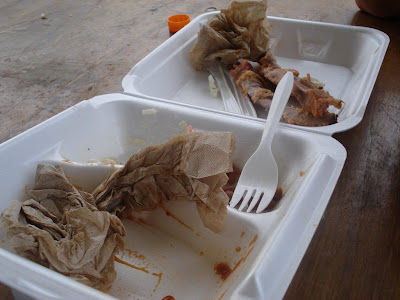
But Bhutan and Texas were pretty cool. Mostly, GFD and I ate our way through both cultures. We went to the Texas BBQ house and ate ribs.

Texas ribs Folklife Festival
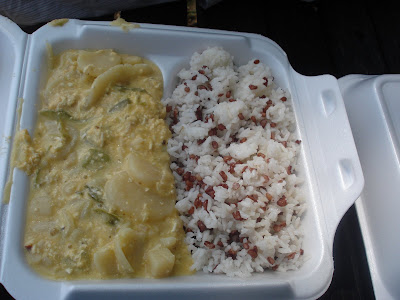
Then we went ate the national dish of Bhutan, ema datsi, which is chilies with cheese and potatoes, and white rice with some kind of red rice mixed in. To be honest, we were nervous. But it turns out, it tasted like queso with jalapenos. Not so weird or exotic. It actually might have come out of an industrial can of nacho-grade queso, so underwhelming overall. We did think it was funny that the same thing could have been purchased at the Tex Mex booth, and we probably wouldn't have noticed. We also ate pork dumplings (God I love dumplings) inexplicably served with salsa that also seemed to have borrowed from the Tex Mex booth.
Ema Datsi Folklife Festival
The music part of the Texas exhibit was great, with an opry house tent, and a dance hall tent. We heard country music, two stepping, and mariachis in the course of the hour we were there. And the arts and crafts piece of the Bhutan exhibit was pretty good too. Their weaving and textiles are bright and fun, with Buddhas and dragons and bright pinks knit with reds and blues and greens in lively patterns. They even assembled a model Buddhist temple, the pieces of which were hand crafted in Bhutan and shipped to Washington, DC for assembly. And inside, there were live monks making music (and looking remarkably hot and bored)!
Monks from Bhutan Folklife Festival

It's too late for this year if you missed it, but next year be sure to go, even though you are guaranteed to dissolve into a sweaty mess. There is great music, good food, and a lot to see and do. I imagine if you have children, it is an ideal place to let them run and see and touch and dance. And maybe next year, they will focus on three actual folk cultures. Or maybe they will highlight the Department of Homeland Security instead.

Coming up: SotG!!!!! See you there! HBO Dance-off promptly at dusk.

Join me over at the
Cork & Knife, where I tackle jam-making.
Get in my belly.

Tuesday, June 10, 2008

Thing 113: The Portrait Gallery

On Friday, I took the afternoon off of work, for no better reason than it's summer and GFD and I wanted to do frivolous things. We drank bloody Marys and ate fried zucchini for lunch, saw the Sex and the City movie, and finished with wings and tackiness at Hooters.

But we didn't want it to be all frivolity, so we threw some legitimate culture in there, too. We stopped in at the National Portrait Gallery to see a couple of exhibits that I've had my eye on for awhile.

I haven't spent a whole lot time in the Portrait Gallery. For the first several years I was in DC, it was under renovation and then when it finally opened I did a quick lap around it and then gave up and had lunch at Zaytinya. This time around, I specifically wanted to see the exhibit of hip hop portraits and of Herblock cartoons, and I quite enjoyed them both.

The hip hop exhibit was bright and playful and, as someone was has listened to hip hop since her formative years, a real acknowledgement that the cultural movement that is hip hop is worth celebrating within our larger culture of the arts. Thirty years ago when street kids were tagging subways in the Bronx, did they ever think that graffiti art would be lining the hallways of the Smithsonian? And yet here were huge, colorful tags spray painted on canvasses along the marble floored hallways, commanding respect as Art.

There were also some beautiful black and white portraits of artists on stage and back stage, including my love, Mos Def, and some really great ones of Erykah Badu, Public Enemy and ?uestlove. There was a video installation, and a spoken word/mixed media room but my favorite were the enormous portraits by Kehinde Wiley, bright with patterns and vitality, of various members of hip hop 'royalty' (LL Cool J, Ice T, Grandmaster Flash and the Furious Five) posing in the style of noblemen past. The musicians are posed with objects showing their style and wealth, in front of neon repeating patterned backgrounds and with a large crest to identify who they are (LL's crest for example included a pair of boxing gloves and a Kangol hat. Don't call it a comeback...). Here, Ice T is posed in the manner of the Emperor Napoleon -- ruling over his domain.


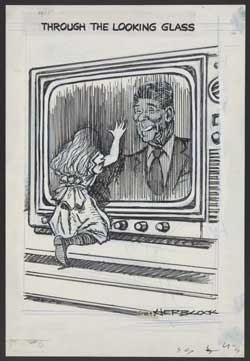
The other exhibit we saw was the Herblock political cartoons. I have lived in DC just long enough that I remember seeing his works in the Post, as he was nearing the end of a long and storied career. Herblock was a master at the political satire, and spared no president from his harsh pen. This exhibit covers a sampling of his cartoons of FDR, Truman, Eisenhower, JFK, LBJ, Nixon, Ford, Carter, Reagan, Bush I and Clinton. The opening text for the exhibition specifically states that only cartoons that aren't nice to their subjects were selected, and Herblock spares no one as he points out corruption, indifference or hypocrisy. Clinton washes his hands of the ethnic cleansing in Bosnia, Johnson neglects and under funds his War on Poverty and Kennedy cowered as dictators took over Latin America. This exhibit goes hand in hand with Berryman's exhibit at the National Archives, and it's a great way to learn about history -- through the eyes of cynical and humorous cartoonists.


I loved both of these exhibits, and I think they are each a good example of some of the more forward ways the portrait gallery is defining portraiture. Sharp caricatures and classic portraits of modern figures, mixed media art installations about how we see ourselves, and even the graffiti tag as self portrait because that's how the graffiti artists choose to present themselves outwards to the world...they're all housed in the same place as the oil paintings of George Washington.
The hip hop exhibit is on until the end of October, and Herblock is up through the end of November, and I'd urge you to check them out next time you're up for a bit of summertime frivolity.

Friday, April 11, 2008

Thing 107: The George Mason Memorial

George Mason MemorialPoor George Mason. The forgotten founding father. Oh sure, he has a university in his name, but where oh where is his memorial? Lincoln sits stately in his marble palace. George Washington’s phallus towers over the skyline. Jefferson keeps watch over the Tidal Basin beneath his dome. Rappers lament their lack of “Benjamins, baby,” an homage to Franklin’s perch on the $100 bill.

Don’t fret, Mason lovers! Six years ago, your man Georgie got his due, with a small memorial tucked away near the Jefferson along the banks of the Tidal Basin. We stumbled upon it last weekend when were returning from a picnic beneath the blossoms.

George Mason Memorial
It is a small and peaceful place. A small reflecting pool surrounded by flowers. Words from the Virginia Declaration of Rights, which was used as the blueprint for the Bill of Rights, are carved into the marble walls. A large bronze statue shows Mason in contemplative relaxation. He sits under an awning, his cane resting on the bench, legs casually crossed, looking out into the distance with a finger holding the place in his book. He’s about twice the size of a real person, dressed in knickers and a cravat, looking like a person who is about to found a nation.

George Mason Memorial

Thursday, March 6, 2008

Thing 102: Take a Cooking Class

When I was little, I used to watch Saturday morning cooking shows on PBS with my dad. Yan Can Cook, the Frugal Gourmet, and of course Julia. I liked Martin Yan the best, which I know will horrify the Julia devotees reading, but he had a lot of flare and panache and after all, I was five.
I really loved how the chefs had all their little bowls of pre-measured ingredients which they would throw in the pot with abandon, and then about halfway through the demonstration, the chef would say "I just happen to have a finished one right here" and would pull out from below the counter top a perfect, finished roasted duck or apple tart.

I was transported back to those Saturday mornings when I attended a cooking class at Whole Foods on sea vegetables last night. Taught by Rachel Brumitt, a local personal chef and a veritable encyclopedia on vegan and raw cooking methods, I was originally drawn to this class because I did not know one single thing about cooking with seaweed. I vaguely knew that it was healthy and I've used dried nori sheets to make sushi rolls and that was it. I like to fill in the gaping holes in my cooking knowledge and so I signed up.

Folks, these classes are FREE, and they are an incredible resource for learning about different ethnic cuisines or ingredients. I watched wakame sheets hydrate and unfold. I learned that sea vegetables are a great source of iodine, and flush toxins, heavy metals and even radiation from the body. I learned that seaweeds contain the same minerals that are in sea water, which are the same minerals we have in our blood. Most amazingly, as a skeptic of all things vegan and a devoted sweet tooth, I ate really well.

Rachel made four dishes: a sea vegetable and artichoke tapenade (which rocked), a wakame cucumber and orange salad, a condiment of pumpkin seeds and dulce, and a vegan blueberry pudding that was thickened with agar and sweetened with maple syrup and somehow came out creamy and really delicious. And just like those magical TV shows from my childhood, everything was ready to go, portions measured, cooked on the spot, and at one point she even said "and this is what it will look like" and had a pre-made blueberry pudding ready to go! And unlike those shows on PBS, here we could smell and eat and ask questions.

Does a Thing at Whole Foods violate the spirit of DC365 by involving a chain, and an activity that probably happens at Whole Foods around the country? Maybe. But I'm going to go ahead and include it because for one thing, it was a really fun and different thing for me to do with a Thursday night, and for another thing the classes use local talent, local experts, and local suggestions for topics. For more information about the classes offered at Whole Foods, click here.

One year ago: Snow and toddies at the Tabard Inn.

Coming up: St. Patrick's Day parade on March 16th.

Monday, February 18, 2008

Thing 98: See the Constitution!

Thing 98: See the Constitution! Or, um, not.

Don't see the Constitution
Let me explain. I had a friend in town this weekend. He is an old and dear friend, who I've known since the ninth grade. He has now made this perfectly silly choice to go to law school. In an attempt to support this newfound interest in the law, I suggested that while he was in town -- and in between the late nights filled with booze and dancing -- we pay a visit to the Constitution. And while we were at the National Archives, we'd get to see the Declaration of Independence, the Magna Carta and this exhibit of political cartoons I'd seen advertised in the Metro.

Oh, but the Magna Carter was not on display, and neither was the Constitution! The powers that be are making improvements to the case, and so the documents have been holed up somewhere below ground, waiting until they can have an audience once more.

The trip wasn't a complete waste. Frankly, at this point the Constitution is so very faded and worn there isn't much to see, and the really good stuff is in the Bill of Rights anyway, right? In the main rotunda there are lots of other interesting documents, and the masses usually focus on the Constitution, so JFK's speech, the draft of the Articles of Confederation and the original Marbury v. Madison must be grateful to be getting some attention for once.

The special exhibit of political cartooning was really wonderful, too. It is a retrospective of the work of Clifford Berryman, pioneer of the political cartoon, cartoonist for the Washington Post and then the Washington Evening Star from 1898 through 1948. Berryman is the guy who drew that cartoon of the cute, cuddly teddy bear, creating an icon and a symbol of Teddy Roosevelt that stuck with him through his political career.

The cartoons are beautiful, elegant and still very relevant. I particularly liked the one of the Republican candidate, Calvin Coolidge, alone and unencumbered on the putting green as the Democratic candidates for president whacked each other in the Bitter Contest Bunker.

Bitter contest bunker
I also liked the cartoon of the tax payer, being supplicated on all sides by the Republican elephant, the Democratic donkey, and the Progressive goat. Candidates have been promising to cut my taxes since well before I was born -- ain't politics grand?

Aint politics grand?
The entire exhibit is available online, click here to take a look, but if you are in the city head over the archives and see the original. And if you're luckier than my lawyer-in-training friend, you'll get to pop upstairs and see the Constitution while you're there.

Wednesday, January 9, 2008

Thing 93: Tour the West Wing

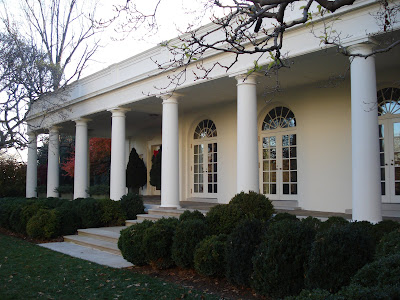
The East Wing of the White House

Hi! Hey there! Sorry I've been gone for so long, but there were the holidays and then the new year, and then I got my wisdom teeth out and well, here I am, back on the blogging horse. And I believe that you were once promised a recap of my tour of the West Wing. In fact, just the other day Sam said to me "you have to write about it before there's a new administration in the White House!"

So, the first thing I have to say is, the actual West Wing of the White House looks nothing like the West Wing, the TV show. The West Wing in the show seemed rather large, with cubicles and desks and glass-walled offices. People were always walking, always on the move, TVs in every corner broadcasting world news.

The West Wing of the White House
The real West Wing is all thick carpets and priceless art work and framed color photographs. The real West Wing is teeny tiny -- the walk between the Oval Office and the Roosevelt Room wouldn't last even half a quip from CJ to Toby. The real West Wing isn't cold and steely, but instead is beautiful and luxurious and elegant.

First things first -- how did I even get in? Well, last month, I received a hurried email from Sam along the lines of "West Wing tour. Send me your social security number ASAP. Details to follow." And faster than you can say "identity theft," I had signed up for a tour led by his friend from church. The cool thing is though that anyone can tour the West Wing (except, you know, terrorists) because not only can executive staff lead tours for their friends and loved ones, but there are tours for the public throughout the week. For more information, click here.


Some day, Sam. Some day.
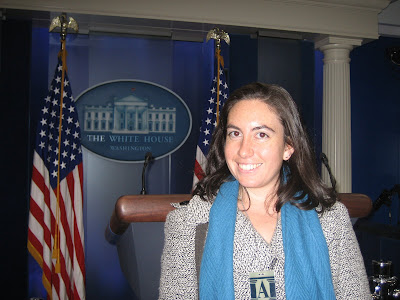
On our tour, we got to visit the press briefing room (!), the colonnade (!), the Roosevelt Room (!), the White House mess hall (!) and OH MY GOD THE SIT ROOM (!!!). Ok, so we weren't allowed to go into the Sit Room. But we did go into the mess hall, and then when we turned around, we were staring at the door of the Situation Room (!!!!!!). Of course, having not gone in, I am still imagining that there's a Big Board with flashing lights and a giant conference table, but whatever it really looks like, just being on the other side of the door was a thrill.


We were IN the WEST WING!!!!
We also got to peek across the threshold of the Cabinet Room (the President's chair is a couple inches taller than everyone else's) and the OVAL OFFICE (!!!!!!!!!!!). The Oval Office is yes, oval, and actually quite small. Also, we learned that each President gets to redecorate it, and this President has made some nice choices, with sunny yellows and sky blues to "symbolize the optimism he feels for the country." He may have missed his true calling as interior designer.

The whole tour took two hours, in part because we absolutely geeked out and took a ton of pictures in the places we were allowed to take them (no inside venues except the press briefing room) and to look at the priceless and magnificent art that is absolutely everywhere. It is a thrill to walk the same hallways as every president since Teddy Roosevelt, to breath in the history and the politics and the excitement, and and to pretend to be CJ Craig.


I have statement from the President...
Get your reservations for restaurant week next week! I should be back up to speed in time to blog Indebleu, Butterfield 9 and Lima. And maybe the Park at Fourteenth? Stay tuned.

Friday, November 23, 2007

Thing 86: The National Gallery, East Wing

It is way too soon after the feast to write a food related post, so Matchbox will have to wait until tomorrow. Instead, I am going to lay on the couch with this pot belly of mine, and ANTM on in the background, and tell you all about the really great Hopper exhibition at the East Wing of the National Gallery.

Edward Hopper at the National Gallery
You haven't seen it yet? You must! A complete and all-encompassing retrospective of his very prolific career, this exhibition follows Hopper from his early etchings, through his watercolors in Glocester, Mass, his oils of lighthouses in Maine, and of course his most famous scenes of New York City. I didn't know much about Hopper going in -- his "Nighthawks" piece, sure, but not much else -- but I must say that after the exhibit, I have a huge appreciation for Hopper and his work.

He was a master of light and shadow. He understood the power of natural light and was able to really beautifully capture the purple shadows in unlikely ways. He also tended to paint unexpected subjects. For example, he painted a whole series of pictures of lighthouses in Maine, but rarely do we see what might be expected at a lighthouse. Namely, the sea. Instead, we see the lighthouse against the hills, the hills with a corner of the lighthouse, the base of the lighthouse with some bushes and trees creating shadows.

Likewise, his famous scenes of people in New York City. He captures unassuming moments, scenes between people or through windows that don't seem noteworthy at all, but instill a sense of isolation or longing in the viewer. In Hopper's world, the theater-goers are more interesting than the movie and each apartment window hides complex lives and ambiguous stories.

There's a brief documentary at the end of the exhibit, a short 15 minute film about Hopper and his work, narrated by Steve Martin. It provides a good narrative and perspective on the paintings you've just seen, and helps to put them into historical perspective. One of the artists interviewed in the film says "I've never met anyone who didn't like Hopper. His works appeal to everyone." I think he may be right, and I urge all of you to see the exhibit before it leaves in January.

Liechtenstein at the National Gallery
We also checked out the bottom floor of the East Wing (and not just the gelato stand), enjoying the Liechtensteins, Warhols and Calders. Yes, there are blank white canvasses and cans of Campbell's soup cans and some weird stuff going on, but it's some of the best weird stuff you can find. And walking around the gallery might help burn off some of those turkey and cheesecake calories.

East Wing at the National Gallery

Thursday, November 15, 2007

Thing 82: The Einstein Planetarium

Einstein Planetarium

Today I played tourist by hitting up the National Air and Space Museum on my lunch break and seeing galaxies collide at the Einstein Planetarium.

When was the last time you've been to a planetarium? For me, I haven't been since I was about eight years old at the Academy of Sciences in Golden Gate Park. I recommend going back to the planetarium than it took me -- the show I saw today was great!

First of all, it's narrated by Robert Redford, who, it turns out, is not only easy on the eyes, but easy on the ears! Second of all, I learned a lot. The show I saw, "Cosmic Collisions," explained how collisions in the universe were responsible for such things as our moon, the Northern Lights, the extinction of the dinosaurs, and billions of years from now the joining of the Milky Way with the Andromeda Galaxy. All brought to you in swirling 3D, with meteorites orbiting above your head and stars twinkling brightly in the night sky.

Tickets for adults cost $8.50, though the museum's admission is, of course, free. Apparently, if you go in the middle of the day the week before Thanksgiving, you don't even have to wait in line! But I can't vouch for more crowded times of the day. I have seen the line stretch far, far back.

Just relax, recline, allow the darkness to envelope you and listen to Robert Redford's narration. Going to the moon and back on your lunch hour is so much more satisfying than another PBJ at your desk.

Sunday, November 11, 2007

Book: Historic Photos of Washington, D.C.

Note: I received a copy of this book free from the publisher for review. That said, I'd like to think that did not affect my review. I'd also like to think it makes me kind of a big deal.

It's got to be pretty clear by now that I geek out pretty hard about DC history. The Barry administration or the Willard or Pierre L'Enfant? Yes, please.


The pictures in Historic Photos of Washington D.C. feed that geek in me. I really enjoyed the pictures of DC street cars, the Capitol without its dome, Union Station without its fountain and Georgetown back when it was a wide open space. F Street and Chinatown were composed of quaint store fronts, mom 'n' pop shops or the shiny new department stores like Woodward & Lothrop (now closed) and Hecht's (now closed).

Besides the novelty of seeing a horse-drawn cart making a delivery to the White House, I learned a lot from this book, too. For example:
  • James Renwick, Jr. designed the Smithsonian Castle in 1847, which was then built using red Seneca sandstone.
  • Dupont Circle used to be called Pacific Circle. It was rechristened Dupont Circle in 1921 with the fountain, titled "Rear Admiral Samuel Francis DuPont Memorial Fountain." DuPont was the first naval hero of the Civil War. The three figures on the fountain represent the sea, the stars and the wind.
  • DC has pretty much always been ineffective at snow removal.
  • The Memorial Bridge opened in 1932 and was meant to be a symbolic rejoining of the North and South by connecting the Lincoln Memorial to Arlington National Cemetery.
  • The building that is now Ben's Chili Bowl used to be a burlesque house called the Gayety!
My only criticism of this beautiful book is there are too many officials pictures -- lots of presidents at the White House, processions down Pennsylvania Avenue and the monuments looking lovely. I would have liked more pictures of some different neighborhoods, especially Shaw and Howard, Foggy Bottom, Anacostia and Petworth. Considering the huge influx of African Americans to the capital after the Civil War, the book is filled mostly with white faces.

But even for its short comings, this book is essential to anyone seeking historic understanding and perspective on this ever-changing city.

Wednesday, November 7, 2007

Thing 77: Olsson's Books and Records

I needn't have panicked, of course, because in this city, great Things are happening every day.

Take Olsson's Books and Records shops for

example. They have author events, signings and readings going on nearly every day. There is likely to be something that will please everyone in any given month, and for me, that something was Anthony Bourdain. Live, in the flesh, and telling it like it is.

Most people don't know this -- in fact, I don't think anyone knows this -- but Bourdain is one of the three people that spurred me to start this blog in the first place. I'd just finished reading A Cook's Tour, and was struck by his narrative style, his knack for the travelogue and the casual, humorous and honest ways he looked at food and travel. Unfunded by cable TV, I don't the means to do what he does in quite the same way, but darned if I couldn't write a fantastic travelogue about the city I'm in love with, which I am lucky enough to experience every day. (The other two people were Molly, and the Boyfriend, if you were curious).

So Tony holds a special place in my heart, even though he would probably ruthlessly make fun of me if I ever had the opportunity to tell him so. At 11:45 I ducked out of work and took the bus to Chinatown.

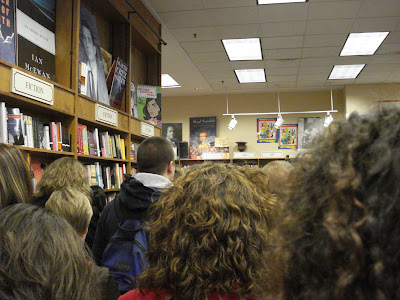
I was not the only one with this idea. By the time I rolled in, a few minutes after noon, I couldn't even find a place to stand where I could see the man. It was like Bourdain Radio, with a view of the backs of people's heads.

My view at Olsson's -- the backs of peoples' heads
But I could hear his voice, and what a voice he's got. I suppose he wouldn't be a successful author if didn't have a distinctive voice, but having now heard him live and off the cuff, I can vouch that he speaks with the same snarky bluntess that he writes with and that pervades all of his TV appearances. He's half jerk and half best friend, heaping honest praise on those that deserve it, and mercilessly ridiculing those that deserve it, too.

Anthony Bourdain! Live!
Bourdain on vegetarians*: If you are priviledged enough to be one of the few people who is even able to go to Thailand and you don't eat everything in sight, it's not just rude, it's dumb. It's like going to a museum and saying 'I only want to see the paintings in blue and red.'

On which Food Network chefs are worth their salt: Mario. Mario is a behemoth. He knows everything, about everything. Those are cloven hoofs he's got hiding in those plastic clogs.

On which Food Network chefs are not: People would complain if I went on TV and told all the kids at home to listen to Judas Priest records backwards, and then go into the woods and slaughter goats. But that's what that Sandra Lee is doing! Putting spray cheese on a Triscuit and telling people it's a healthy, homecooked meal for their families -- it's the same thing.

On why his show is no longer on the Food Network and on Travel Channel instead: They came up to me and said, "We want more BBQ shows. Our audience doesn't really get this thing you do where you go to other places. They don't do subtitles. But our grilling shows get huge ratings. What if you went to different tailgating parties instead?"

On whether he ever gets sick from the foreign food: Most of the times that I've ended up with my head in a bidet some place foreign, it's been alcohol related.

On where he plans on eating dinner that night: Ben's Chili Bowl. Ground meat of unknown origin? How can I say no?

Olsson's has a pretty strict system for getting books signed. You have to a) buy the book that day, at Olsson's b) then they will give you a numbered card and c) then you wait in line based on the number of that card. I was still on my lunch hour, so I ducked out shortly after his talk, but I did manage to sneak up to the front and get his picture as he was signing. Skinny black jeans, boots, dark shirt, silvery hair. He looked tanned and a bit gaunt, just like on TV, but, you know, in three dimensions.

For those of you who want more Tony -- he'll be at Lisner tonight, though it's sold out, and from his lips to your ear he'll be at Ben's tonight for dinner.

*These quotes are from my memory, as I wasn't taking notes or recording it. I'm a blogger, not a journalist!

Thursday, July 19, 2007

Thing 51: The Museum of Natural History

50 "things" and not one Smithsonian? Is this possible? Let's correct that right now, shall we?

T-Rex skull
Last weekend, the Boyfriend and I ventured into the pits of tourist hell when we spent a couple hours at the Smithsonian's Museum of Natural History. I had slept right through the Market, after the exertion of the Mos Def concert, and by the afternoon I got to feeling restless. I was overwhelmed by the need to see some dinosaur bones. And the Boyfriend, because he loves me, humored me in this, even though fanny packs make him physically ill.

We entered the Museum of Natural History from Constitution Avenue, and immediately upon passing through the metal detector, I was face to face with an authentic maoi statue. You know, one of those Easter Island heads. Devotees will remember that this statue completely stumped me and GFD during our Urban Dare adventure, and was the only thing keeping us from victory. So, with this picture I have officially completed the Urban Dare. Ahem, it only took me three months.
An authentic maoi statue.  Finally.  Urban Dare is complete.
From the Constitution Avenue entrance, we had to go up a narrow escalator and then we were in the atrium of the museum, a wide, circular space at whose center is a a replica of an enormous tusked elephant walking through African sand. The atrium is lit through the sky light at the top of the large dome in the ceiling. The second floor's balcony is propped up by narrow, white marble columns. There is a desk for information, a desk at which to buy tickets for the I-MAX, and signs directing visitors towards all the various exhibits.

The atrium at the Museum of Natural HistoryBut mostly, there are tourists. It is July. In our nation's capital. In probably the second most kid-friendly museum in the city (second only, I'm guessing, to the Air and Space, which I simply am not going to venture into until at least October when the greatest gush of tourism will have subsided). It's not like I was surprised to find a sweaty, screaming, crying, running, hungry, cranky, photographing, bored and matching-shirted crowd there. I was ready. I had steeled myself. Still, it was overwhelming. Do tourists even enjoy the experience of the museum, or are there too many other tourists there for them to get even a moment to catch their breath and appreciate?
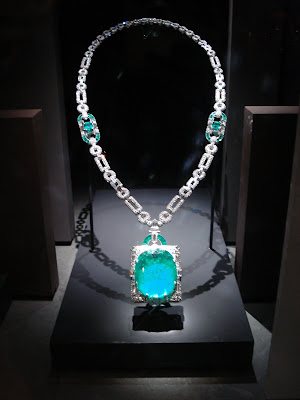
Which is kind of how I felt. The Boyfriend and I headed up first to the geology room, to see the shiny jewelry. In order to get to that great, glittering, blue behemoth that is the Hope Diamond, you have to wind your way through all these different exhibits about plate tectonics, meteor showers, earthquakes, mining and mineral deposits before you get to the pretty things. So much to learn, and so many people in the way. Every explanatory plaque, every interactive exhibit, every square inch of thick glass encasing twinkly gems was blocked by tourists in high-wasted shorts, their eager children or their impossibly bored teenagers. I can't say I learned much. Except that I really hope that, when the Boyfriend wins a bajillion dollars playing lotto someday, that he buys me a 142 carat emerald and diamond necklace.

Someday, necklace, you will be mine.
We strolled down to look at the dinosaur bones, too. Again, there were so many people everywhere that I didn't really feel at leisure to learn much. Stegosaurus bones are cool. T-Rex's skull is neat. And, um....strollers look hard to steer.

Stegosaurus skeleton
There was also a really wonderful exhibit of nature photography. This I can happily and highly recommend. Even though it was also packed, I felt able to wander and admire and read without too much tourist interference. The photographs were all prize winning, the best of the best from the 2006 Nature’s Best Photography Windland Smith Rice International Awards and the National Wildlife Photography Awards competitions. Each category had an amateur and a professional winner and the categories covered everything from birds to landscapes to human interactions with nature. All the pictures were displayed in full, perfect color, on large, glossy poster boards. One was an arctic sunset, with dark blues and bright pinks. One was of a big brown bear, rolling on his back, seemingly laughing. And there was this one, the grand prize winner of the whole competition:

Monkeys!
The Boyfriend and I only lasted about an hour and a half before we had to get out of the crowd. There is so much to see, the stuffed mammals, the live spiders, the I-MAX movie about sharks. We will probably go back another time, when things quiet down. But right then, I needed to get out of there. The ginger chocolate chip molasses cookies I baked when we got home helped us recover. The best cookies you will ever eat.