Find party invitations for any occasion at eInvite.com. Personalize, preview, and order your invitation instantly.
Showing posts with label Museums. Show all posts

Tuesday, June 16, 2009

Thing 115, Revisited: Hillwood Estate Movies and Picnic

The Hillwood Estate One in Ten old movie evening resumed again last Friday, this time showing one of my absolute favorites: How To Marry A Millionaire. Everything I remembered about Hillwood outdoor movies was true: lush lawn, gorgeous grounds, fabulous movies and elaborate picnic setups.

This year, Kate and I brought our A games, after setting up a pretty pathetic picnic last year. This year, after some pretty intensive planning, I think we did pretty well:


A crisp white cloth, assorted crudites and dips, homemade pita, homemade shortbread cookies, sparkling wine. Even candles, china and real silverware. The judges were impressed. Wouldn't you be?
But not only was our spread a looker, but so were we! We were inspired by Marilyn and Lauren and their fabulous outfits and tried to snag our own millionaires.

And for our trouble, we got an honorable mention! Our prize was a goody bag with some Hillwood-themed items, and two free passes to tour the house and grounds! So we will be back to spend some quality time immersed in Marjorie Merriweather Post's impeccable taste and largesse.

Thanks Hillwood!

(If you're hot to buy some of those silver interlocking containers, they're called tiffins and you can find them here.)

One year ago: Squash blossoms stuffed with goat cheese in tomato sauce from Oyamel.

Friday, January 30, 2009

Thing 135: The United States Botanic Garden

January has been kind of rough, right?

It's not just me and my thin, grew-up-in-California skin is it? I mean, it's been COLD outside, right? That was a lot of snow and ice, right? And, if I recall the last ten winters I've spent in this District, February is always our coldest month. We always get our city-shuts-down snow storm in February, and it's always impossibly, bitterly cold in February which makes me mad every year because spring is in sight. So we're not even to the worst of it, despite how frozen my toes got on Inauguration Day.

But now, I have a plan for getting through it.

Because my most glorious, impromptu and inexpensive Saturday was not over yet, after the hairballs and the ackee. Oh, no. We then proceeded south, into the warm, tropical, humid embrace of the US Botanic Garden.

The Botanic Garden is free. And warm. And beautiful. And there are copious benches in all of these free, warm, beautiful rooms. Are you picking up what I'm putting down? Why am I not reading in the Botanic Garden all the time?!

I could peel off layers and be comfortable in a t-shirt. I could change into flip flops. I could spend the whole afternoon there and catch up on issues of the New Yorker and overdue library books. I could break a sweat. This is very exciting to me.

But don't tell anyone my secret, OK? I want to ensure that I have some bench space to myself once February hits.

The Boyfriend took some great pictures during our visit. Enjoy!


PS - I finally got around to updating the DC365 City Guide -- so check out the link on right to find something to do no matter what your mood or location!


Monday, January 26, 2009

Thing 133: The National Museum of Health and Medicine


My grandparents had hoped my uncle would grow up to be a doctor. My grandfather was a doctor, and both of my grandmother's brothers as well as her father were doctors. So it was perhaps only natural that they would expect their only son to follow in the family business and heal the sick.

With these high hopes -- or so goes the family lore -- they paid a visit to a museum of medical oddities when my uncle was still a young and impressionable boy. My grandfather had hoped that the array of weird things floating in jars would pique the boy's interest. Instead, my uncle was so horrified by the entire experience that he swore he'd never become a doctor. He still recalls the experience with disgust and horror.

So it was with great excitement and not a small amount of trepidation that I agreed to visit the National Museum of Health and Medicine, located at Walter Reed Army Medical Center. I had heard that this museum had the bullet the killed Lincoln, fetuses in jars, and medical oddities of all kinds including the world's biggest hairball. I'm fairly squeamish, so while I was really intrigued, it wasn't out of the question that I might pass out on the premises.


Well, I remained conscious although there were a couple things that turned my stomach (especially the leprosy pictures and the leeches). Mostly though, the museum focuses on military medical history starting with the Civil War through the current conflict in Iraq. In particular, it chronicles the advances of caring for the war wounded, improvements in field hospitals and ways to identify those who died during war. There is also an extensive exhibit on the evolution of the microscope -- from Anton van Leeuwenhoek (hello seventh grade science!!) to modern electron microscopes.


But it's not all tame and historical. There is some weird, gross and even funny stuff in the collection too.

Take, for example, the world's biggest hairball. It was removed from the stomach of a 12 year old girl who had been eating her hair for six years and it was the exact shape of her stomach. Eww!


Or how about the preserved tongue and esophagus of someone who died while choking -- it's floating in formaldehyde along with the enormous piece of steak that the person died trying to eat.

Cross sections of lungs taken from coal miners (pitch black), iron minors (dark red), smokers (gray with white cancer) and city dwellers (distressingly, alarmingly nearly as gray as the smokers' lungs).


There was also an exhibit on misguided medical equipment, including an x-ray machine that x-ray'ed people's feet in their shoes at the shoe store to ensure that they fit properly. We watched a rather charming video about the machine in which we learned that these machines emitted 25 rems per minute in order to ensure that your shoes fit properly (recommended radiation exposure for nuclear power plant employees is not to exceed 5 rems per year!). About 20 years later, when shoe salesmen started dying of cancer left and right, the machines declined in popularity.


There is a lot to see at this museum -- it's free, and easily accessible from the 70 bus. You will need to show your ID in order to get onto the property though. If you like history, military history, science, medical facts or just really gross/weird stuff, you've got to go. I imagine that young boys might especially like this museum -- unless you're trying to initiate them into a medical career-- then it might backfire. Just ask my uncle.

Sunday, January 11, 2009

Thing 128: The 13th Annual Iranian Film Festival

So, here's the thing when you open yourself up to new cultural experiences and your only criteria is that it be free:  sometimes, those experiences suck.


It was truly with an open mind and fairly high hopes that Good Friend David and I headed to the Freer Gallery on Friday night to take in Banana Skin, the film that would kick off the 13th Annual Iranian Film Festival.  Despite a degree in Middle Eastern Studies, I admit to being fairly ignorant about Iranian culture though I've heard rumors that it's vibrant, critical and exciting.

Unfortunately, the movie was none of those things.  It was an unfunny comedy, poorly acted and lacking a plot that -- how do I put this delicately -- made any sense.  The rough story is much like It's A Wonderful Life, except the opposite.  A business man so focused on making money that he has no personal life to speak of gets hit by a car and falls into a coma (are we laughing yet?).  While 'dead,' he falls in love with a beautiful woman in the afterlife.  When he wakes from the coma, he decides that the only way he can be happy is to be reunited with his love.  Which means he has to die.  Except that suicide is a sin.  So he has to die 'accidentally.'  So he hires a hit man to murder him, but the hit man is a heroin addict who forgets to kill him.  

Never have I been so nostalgic for George Bailey's rosy-cheeked children and their glee at bell-ringing.

I'd love to expound about how the different viewpoints (better off dead v. better off alive) is a metaphor for the hopeless situation in Iran whereas the American dream allows for hope and optimism.  I am sure that that would be woefully misguided.  Sometimes a bad movie is just a bad movie, and I'd sure hate for all of American culture to be judged on Sweet Home Alabama.  

I should also mention that it was pretty obvious that the subtitling was terrible.  If I spoke Farsi, this may have been an adequate movie rather than a poor one, but I can't imagine it transcending higher than that.  I'm puzzled by its inclusion in a festival designed to highlight the films of Iran, which have to get better than this.

The festival continues through February with five other films, all of which are shown free of charge at the Freer.  While I can't in good conscience recommend Banana Skin, I do urge you to cast the dice and check out one of the remaining films.  If you do, please report back in the comments and let me know your thoughts.

Tuesday, June 10, 2008

Thing 113: The Portrait Gallery

On Friday, I took the afternoon off of work, for no better reason than it's summer and GFD and I wanted to do frivolous things. We drank bloody Marys and ate fried zucchini for lunch, saw the Sex and the City movie, and finished with wings and tackiness at Hooters.

But we didn't want it to be all frivolity, so we threw some legitimate culture in there, too. We stopped in at the National Portrait Gallery to see a couple of exhibits that I've had my eye on for awhile.

I haven't spent a whole lot time in the Portrait Gallery. For the first several years I was in DC, it was under renovation and then when it finally opened I did a quick lap around it and then gave up and had lunch at Zaytinya. This time around, I specifically wanted to see the exhibit of hip hop portraits and of Herblock cartoons, and I quite enjoyed them both.

The hip hop exhibit was bright and playful and, as someone was has listened to hip hop since her formative years, a real acknowledgement that the cultural movement that is hip hop is worth celebrating within our larger culture of the arts. Thirty years ago when street kids were tagging subways in the Bronx, did they ever think that graffiti art would be lining the hallways of the Smithsonian? And yet here were huge, colorful tags spray painted on canvasses along the marble floored hallways, commanding respect as Art.

There were also some beautiful black and white portraits of artists on stage and back stage, including my love, Mos Def, and some really great ones of Erykah Badu, Public Enemy and ?uestlove. There was a video installation, and a spoken word/mixed media room but my favorite were the enormous portraits by Kehinde Wiley, bright with patterns and vitality, of various members of hip hop 'royalty' (LL Cool J, Ice T, Grandmaster Flash and the Furious Five) posing in the style of noblemen past. The musicians are posed with objects showing their style and wealth, in front of neon repeating patterned backgrounds and with a large crest to identify who they are (LL's crest for example included a pair of boxing gloves and a Kangol hat. Don't call it a comeback...). Here, Ice T is posed in the manner of the Emperor Napoleon -- ruling over his domain.


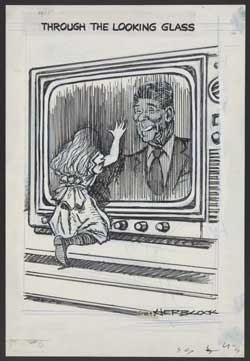
The other exhibit we saw was the Herblock political cartoons. I have lived in DC just long enough that I remember seeing his works in the Post, as he was nearing the end of a long and storied career. Herblock was a master at the political satire, and spared no president from his harsh pen. This exhibit covers a sampling of his cartoons of FDR, Truman, Eisenhower, JFK, LBJ, Nixon, Ford, Carter, Reagan, Bush I and Clinton. The opening text for the exhibition specifically states that only cartoons that aren't nice to their subjects were selected, and Herblock spares no one as he points out corruption, indifference or hypocrisy. Clinton washes his hands of the ethnic cleansing in Bosnia, Johnson neglects and under funds his War on Poverty and Kennedy cowered as dictators took over Latin America. This exhibit goes hand in hand with Berryman's exhibit at the National Archives, and it's a great way to learn about history -- through the eyes of cynical and humorous cartoonists.


I loved both of these exhibits, and I think they are each a good example of some of the more forward ways the portrait gallery is defining portraiture. Sharp caricatures and classic portraits of modern figures, mixed media art installations about how we see ourselves, and even the graffiti tag as self portrait because that's how the graffiti artists choose to present themselves outwards to the world...they're all housed in the same place as the oil paintings of George Washington.
The hip hop exhibit is on until the end of October, and Herblock is up through the end of November, and I'd urge you to check them out next time you're up for a bit of summertime frivolity.

Monday, February 18, 2008

Thing 98: See the Constitution!

Thing 98: See the Constitution! Or, um, not.

Don't see the Constitution
Let me explain. I had a friend in town this weekend. He is an old and dear friend, who I've known since the ninth grade. He has now made this perfectly silly choice to go to law school. In an attempt to support this newfound interest in the law, I suggested that while he was in town -- and in between the late nights filled with booze and dancing -- we pay a visit to the Constitution. And while we were at the National Archives, we'd get to see the Declaration of Independence, the Magna Carta and this exhibit of political cartoons I'd seen advertised in the Metro.

Oh, but the Magna Carter was not on display, and neither was the Constitution! The powers that be are making improvements to the case, and so the documents have been holed up somewhere below ground, waiting until they can have an audience once more.

The trip wasn't a complete waste. Frankly, at this point the Constitution is so very faded and worn there isn't much to see, and the really good stuff is in the Bill of Rights anyway, right? In the main rotunda there are lots of other interesting documents, and the masses usually focus on the Constitution, so JFK's speech, the draft of the Articles of Confederation and the original Marbury v. Madison must be grateful to be getting some attention for once.

The special exhibit of political cartooning was really wonderful, too. It is a retrospective of the work of Clifford Berryman, pioneer of the political cartoon, cartoonist for the Washington Post and then the Washington Evening Star from 1898 through 1948. Berryman is the guy who drew that cartoon of the cute, cuddly teddy bear, creating an icon and a symbol of Teddy Roosevelt that stuck with him through his political career.

The cartoons are beautiful, elegant and still very relevant. I particularly liked the one of the Republican candidate, Calvin Coolidge, alone and unencumbered on the putting green as the Democratic candidates for president whacked each other in the Bitter Contest Bunker.

Bitter contest bunker
I also liked the cartoon of the tax payer, being supplicated on all sides by the Republican elephant, the Democratic donkey, and the Progressive goat. Candidates have been promising to cut my taxes since well before I was born -- ain't politics grand?

Aint politics grand?
The entire exhibit is available online, click here to take a look, but if you are in the city head over the archives and see the original. And if you're luckier than my lawyer-in-training friend, you'll get to pop upstairs and see the Constitution while you're there.

Friday, November 23, 2007

Thing 86: The National Gallery, East Wing

It is way too soon after the feast to write a food related post, so Matchbox will have to wait until tomorrow. Instead, I am going to lay on the couch with this pot belly of mine, and ANTM on in the background, and tell you all about the really great Hopper exhibition at the East Wing of the National Gallery.

Edward Hopper at the National Gallery
You haven't seen it yet? You must! A complete and all-encompassing retrospective of his very prolific career, this exhibition follows Hopper from his early etchings, through his watercolors in Glocester, Mass, his oils of lighthouses in Maine, and of course his most famous scenes of New York City. I didn't know much about Hopper going in -- his "Nighthawks" piece, sure, but not much else -- but I must say that after the exhibit, I have a huge appreciation for Hopper and his work.

He was a master of light and shadow. He understood the power of natural light and was able to really beautifully capture the purple shadows in unlikely ways. He also tended to paint unexpected subjects. For example, he painted a whole series of pictures of lighthouses in Maine, but rarely do we see what might be expected at a lighthouse. Namely, the sea. Instead, we see the lighthouse against the hills, the hills with a corner of the lighthouse, the base of the lighthouse with some bushes and trees creating shadows.

Likewise, his famous scenes of people in New York City. He captures unassuming moments, scenes between people or through windows that don't seem noteworthy at all, but instill a sense of isolation or longing in the viewer. In Hopper's world, the theater-goers are more interesting than the movie and each apartment window hides complex lives and ambiguous stories.

There's a brief documentary at the end of the exhibit, a short 15 minute film about Hopper and his work, narrated by Steve Martin. It provides a good narrative and perspective on the paintings you've just seen, and helps to put them into historical perspective. One of the artists interviewed in the film says "I've never met anyone who didn't like Hopper. His works appeal to everyone." I think he may be right, and I urge all of you to see the exhibit before it leaves in January.

Liechtenstein at the National Gallery
We also checked out the bottom floor of the East Wing (and not just the gelato stand), enjoying the Liechtensteins, Warhols and Calders. Yes, there are blank white canvasses and cans of Campbell's soup cans and some weird stuff going on, but it's some of the best weird stuff you can find. And walking around the gallery might help burn off some of those turkey and cheesecake calories.

East Wing at the National Gallery

Thursday, November 15, 2007

Thing 82: The Einstein Planetarium

Einstein Planetarium

Today I played tourist by hitting up the National Air and Space Museum on my lunch break and seeing galaxies collide at the Einstein Planetarium.

When was the last time you've been to a planetarium? For me, I haven't been since I was about eight years old at the Academy of Sciences in Golden Gate Park. I recommend going back to the planetarium than it took me -- the show I saw today was great!

First of all, it's narrated by Robert Redford, who, it turns out, is not only easy on the eyes, but easy on the ears! Second of all, I learned a lot. The show I saw, "Cosmic Collisions," explained how collisions in the universe were responsible for such things as our moon, the Northern Lights, the extinction of the dinosaurs, and billions of years from now the joining of the Milky Way with the Andromeda Galaxy. All brought to you in swirling 3D, with meteorites orbiting above your head and stars twinkling brightly in the night sky.

Tickets for adults cost $8.50, though the museum's admission is, of course, free. Apparently, if you go in the middle of the day the week before Thanksgiving, you don't even have to wait in line! But I can't vouch for more crowded times of the day. I have seen the line stretch far, far back.

Just relax, recline, allow the darkness to envelope you and listen to Robert Redford's narration. Going to the moon and back on your lunch hour is so much more satisfying than another PBJ at your desk.

Tuesday, September 18, 2007

Thing 61: Arts on Foot

Arts on Foot Festival 2007

Oh, DC. It is so good to be back. How I’d missed you.

The west coast is nice and all, but you have to drive everywhere and public transportation, if it exists, costs a lot more than Metro. Sure I got to eat at Chez Panisse and the Bi-Rite Creamery, but give me Central or Larry’s Homemade any day of the week. I’ll trade in horses and fig trees for the Capitol dome and my trendy corner of Logan any day.

I hit the DC tarmac running, with a weekend chock full of fun DC activities, which I’ll reveal all in due time. Allow me to start with the Arts on Foot Festival. Food! Music! Visual art! Performing art! Comedy! Drama! Cooking! Cheese! Wine!

Welcome home.

What a joy to walk around Penn Quarter in the September sunshine smelling garlic shrimp and listening to a boisterous gospel choir singing “When The Saints Come Marching In.”

I arrived at the festival near 1:00, after a late and large brunch, which I immediately came to regret because of the all the food booths set up from local restaurants. Cowgirl Creamery had a cheese plate, Rosa Mexicana was dishing out fresh, chunky guacamole, and La Tasca was frying shrimp in garlic olive oil and serving them over paella. All the small plates cost $1 - $5, and while I didn’t sample anything, Jodi was able to make a nice mini meal on the cheap.

I wandered over to the Woolly Mammoth Theatre Company, which was selling reduced-priced preview tickets for their upcoming season, selling old props and costumes from prior performances, and offering a behind-the-scenes tour of the theater. After perusing through the leftover junk on sale, I decided to wait for the tour. The tour didn’t start for another 20 minutes, The Timeless Cowrieso I popped across the street to check in with the Bead Museum. Although the sitcoms soundtrack wasn’t playing, it was just as odd as ever. A man stationed at the front was offering the new comers to help them “get oriented” to the museum and its one room. They’ve replaced the Shakespearean exhibit with “The Timeless Cowrie” – a collection of various pieces using the small snail shell that is seen in many parts of the world as sacred or as currency. Or around the necks of stoners and frat boys.

The tour of Woolly of led by the artistic director himself, Howard Shalwitz, and he showed us through the scene shop and into the green room and onto the stage. He explained about how Woolly came to inhabit such prime real estate: the condo complex used to be a federal parcel of land, and the requirement for development was that it must include space for a theater. Woolly signed on with a developer from Texas who worked with them to meet the federal requirements as well as their own, and now they have this angular and spare theater space which includes a fairly large scene shop, two hundred seat courtyard-style theater, and rehearsal and workshop space.
Behind the scenes at the Woolly Mammoth Theater Company
After the tour, I wandered back over to the main area of the festival. They had a tent set up proclaiming "cooking as art," which was holding demonstrations by local chefs. Jodi and I waited patiently for the next demo to start, watching a sous-chef unwrap about fifty small paper plates covered in plastic wrap with pretty pink and pale green foods on them. Then the chef from D'Aqua arrived, spoke briefly about his Italian-style seafood restaurant and the process by which they cure their own salmon in-house. The demo itself consisted of his assistant putting a couple of layers of seafood into a round mold, and the wrapping it in cucumber. And then the masses crowded to the table to demolish the fifty small plates of samples.

Cooking demo - sort of - by the chef from D'Aqua
Finally, we headed to 9th and G, across from the library to the Flashpoint gallery and theater space to see a free performance by the Washington Improv Theater. In the small black box theater, five improvisers did a 'long form' improvised show, meaning that it wasn't the games and short skits you may be used to if you've seen Who's Line Is It Anyway? It's a more theatrical form of improv that attempts to tell multiple stories that thematically come together. It's pretty difficult and some of the threads succeeded and some of them failed, ultimately weaving together stories of tadpoles, hardware scandals and love on a train.

I stuck around for the free workshop they offered after the performance, in which a dozen of us learned some of the very basics of successful improvising. Although I knew many of the games and lessons already (I did quite a bit of improv acting in high school), it was fun to jump back into it and remember the rush of getting on stage without knowing what the other person is going to suggest and just going along for the ride.

And after all that, it was nearing 5:00 and I headed for home, tired from the day and exhilarated from being back in this city, surrounded by art, theater, music, good food and sunshine.

Thursday, July 19, 2007

Thing 51: The Museum of Natural History

50 "things" and not one Smithsonian? Is this possible? Let's correct that right now, shall we?

T-Rex skull
Last weekend, the Boyfriend and I ventured into the pits of tourist hell when we spent a couple hours at the Smithsonian's Museum of Natural History. I had slept right through the Market, after the exertion of the Mos Def concert, and by the afternoon I got to feeling restless. I was overwhelmed by the need to see some dinosaur bones. And the Boyfriend, because he loves me, humored me in this, even though fanny packs make him physically ill.

We entered the Museum of Natural History from Constitution Avenue, and immediately upon passing through the metal detector, I was face to face with an authentic maoi statue. You know, one of those Easter Island heads. Devotees will remember that this statue completely stumped me and GFD during our Urban Dare adventure, and was the only thing keeping us from victory. So, with this picture I have officially completed the Urban Dare. Ahem, it only took me three months.
An authentic maoi statue.  Finally.  Urban Dare is complete.
From the Constitution Avenue entrance, we had to go up a narrow escalator and then we were in the atrium of the museum, a wide, circular space at whose center is a a replica of an enormous tusked elephant walking through African sand. The atrium is lit through the sky light at the top of the large dome in the ceiling. The second floor's balcony is propped up by narrow, white marble columns. There is a desk for information, a desk at which to buy tickets for the I-MAX, and signs directing visitors towards all the various exhibits.

The atrium at the Museum of Natural HistoryBut mostly, there are tourists. It is July. In our nation's capital. In probably the second most kid-friendly museum in the city (second only, I'm guessing, to the Air and Space, which I simply am not going to venture into until at least October when the greatest gush of tourism will have subsided). It's not like I was surprised to find a sweaty, screaming, crying, running, hungry, cranky, photographing, bored and matching-shirted crowd there. I was ready. I had steeled myself. Still, it was overwhelming. Do tourists even enjoy the experience of the museum, or are there too many other tourists there for them to get even a moment to catch their breath and appreciate?
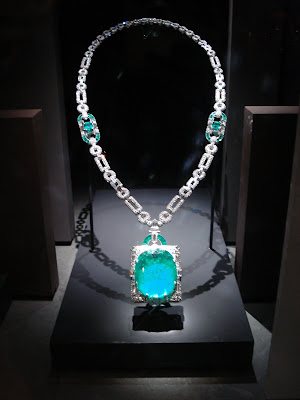
Which is kind of how I felt. The Boyfriend and I headed up first to the geology room, to see the shiny jewelry. In order to get to that great, glittering, blue behemoth that is the Hope Diamond, you have to wind your way through all these different exhibits about plate tectonics, meteor showers, earthquakes, mining and mineral deposits before you get to the pretty things. So much to learn, and so many people in the way. Every explanatory plaque, every interactive exhibit, every square inch of thick glass encasing twinkly gems was blocked by tourists in high-wasted shorts, their eager children or their impossibly bored teenagers. I can't say I learned much. Except that I really hope that, when the Boyfriend wins a bajillion dollars playing lotto someday, that he buys me a 142 carat emerald and diamond necklace.

Someday, necklace, you will be mine.
We strolled down to look at the dinosaur bones, too. Again, there were so many people everywhere that I didn't really feel at leisure to learn much. Stegosaurus bones are cool. T-Rex's skull is neat. And, um....strollers look hard to steer.

Stegosaurus skeleton
There was also a really wonderful exhibit of nature photography. This I can happily and highly recommend. Even though it was also packed, I felt able to wander and admire and read without too much tourist interference. The photographs were all prize winning, the best of the best from the 2006 Nature’s Best Photography Windland Smith Rice International Awards and the National Wildlife Photography Awards competitions. Each category had an amateur and a professional winner and the categories covered everything from birds to landscapes to human interactions with nature. All the pictures were displayed in full, perfect color, on large, glossy poster boards. One was an arctic sunset, with dark blues and bright pinks. One was of a big brown bear, rolling on his back, seemingly laughing. And there was this one, the grand prize winner of the whole competition:

Monkeys!
The Boyfriend and I only lasted about an hour and a half before we had to get out of the crowd. There is so much to see, the stuffed mammals, the live spiders, the I-MAX movie about sharks. We will probably go back another time, when things quiet down. But right then, I needed to get out of there. The ginger chocolate chip molasses cookies I baked when we got home helped us recover. The best cookies you will ever eat.

Wednesday, April 18, 2007

Thing 26: The National Building Museum

I thought I was going to the National Building Museum for an exhibit on greenhouses. You know, like, the architecture of greenhouses…maybe why they grow things so well? It sounded kind of lame, actually. It turns out that the exhibit is on green houses, as in, building environmentally responsible houses with renewable resources. And that the National Building Museum is anything but lame.


The National Building Museum impresses immediately upon entry.Before seeing any exhibits at all, the building itself is a beautiful example of fine architecture and engineering. Upon entering the Great Hall, I was struck by the beauty of the wide and tall space. It is ornately decorated with golden columns, patterned windows, repeating archways, carved marble busts and a large fountain spraying water twenty feet into the air in the center of the open room. The exhibits are tucked into rooms off to the sides of the building, preserving the awesome beauty of the Great Hall. The museum is frequently rented out for stately parties and weddings, including Nancy Pelosi’s party earlier this year, which she threw to celebrate the Democrats’ retaking Congress.

As the Boyfriend, his roommate and I waited for our Some of the windows which literally tower over visitors.two other friends to show up with their young son, we spent the time constructing a large arch out of 21 padded red blocks. The arch (think the arch in St. Louis) is seven feet tall, and takes a bit of planning ahead to place the bases in the right spots, as well as at least one tall person to hold everything up until the key block is put into place. The Boyfriend and I are short, but luckily his roommate is tall and our arch was tall and sturdy. Then comes the fun of destroying it.


By then our other two friends had arrived. They have a young son not yet two years old, and this is a perfect museum for young children. In addition to the fountain to watch, the green house exhibit encourages touching, and there is a playing and learning area designed for young children called the “building zone.”


LED lights, countertops made from paper, and recycled wood.We started by going to the green house exhibit. The exhibit begins with a life-sized model home designed with recycled materials and using renewable energy and energy efficiency techniques. The chairs in the living room are made of recycled seat belts, the kitchen counters are a dense, matte black, and made of what turns out to be recycled paper. LED lights hang from the kitchen ceiling. Handsome recycled glass tiles line the bathroom floor.

Conservation hints are posted throughout the house, explaining easy ways to save water or energy. “Scrape, don’t rinse” it says above the sink, explaining that gallons of water are wasted when you rinse your plates before putting them in the dish washer. The same effect can be achieved by scraping your plates without running water.


After the sample house, we entered the portion of the exhibit showing real life examples of green houses from around the world. Housing developments, from the very expensive to the low-income variety, from around the world are profiled for their use of light and windows, solar panels, heating and cooling systems and land use.


The Colorado Court Affordable Housing Development in Santa Monica. One of ideas so simply brilliant you wonder why you didn't think of it.My favorite was the Colorado Court Affordable Housing development in Santa Monica. It’s a low income housing project that incorporates bright blue solar panels into the façade in a visually pleasing manner. In addition to the aesthetics, the solar panels fulfill nearly all of the building’s electricity needs, thereby reducing the utility bills for the low income residents. It’s a beautiful, brilliant and logical way to incorporate green principles into affordable housing. I don’t know why this hasn’t caught on everywhere.


After learning about green houses (much more interesting than greenhouses), we crossed the Great Hall to spend the next hour in the “Washington: City and Symbol” exhibit. Now, just from the premise of this blog you can probably tell that I am an absolute geek about all things historic, geographic and aesthetic relating to DC. This exhibit is my equivalent of a candy store.


The first room describes the history of the city planning and all the monuments. In includes two full scale models of the National Mall – one before the land was reclaimed for national purposes and one after. The architects of the Capitol, the Jefferson Monument, the Washington Monument and the White House are profiled, their motivations and inspirations explained.

The following rooms show DC’s changing architectural landscapes. Historic shopping corridors, the architecture of the row houses on Capitol Hill, the construction of the “Federal Triangle.” How Union Station came to be – as they were transforming the Mall into a public space for the nation, they had to move the Union Pacific and B & O Railroad hubs, forming one ‘union’ station for the two.


The exhibit describes the history of segregation in public schools and department stores, and explains how the historically black shopping hubs began to decline after segregation was abolished and African Americans could shop on F Street with Whites. (No mention is made of how the historically Black shopping corridors were destroyed during the riots of ’68 and are only just now bouncing back, which I found an odd omission).

I learned that there used to be a covered market, like Eastern Market but much larger, called the Central Market, where the National Archives stand today. The market was torn down by an act of Congress during World War I while they were building the Federal Triangle, and the Archives went up in its place. The architecture of the original building was beautiful, all red brick and ornate spires, and I’m a little sad that it had to be destroyed, even if the building now houses our most important national documents.

5:00 came way too quickly, and suddenly there was a staff member telling us that the museum was closing and that we would have to leave. I wasn’t nearly done with the DC exhibit, and there was still an exhibit about rebuilding the Globe Theater in England and an exhibit of paintings and photography of cityscapes and sky lines that I really wanted to see! The National Building Museum deserves a full afternoon -- if not a whole day -- to really appreciate. I intend on going back and learning more as soon as I can.


Side Note: Some weather we're having! The wind was strong enough on Monday it actually ripped this street sign from its metal pole!


DC street signs have a way of ending up in the oddest places.

Sunday, April 15, 2007

Thing 25: The Bead Museum

It's a...bead.The Bead Museum does some serious multi-tasking. It encompasses a permanent exhibit, two temporary exhibits, a library, a gift shop and an ode to TV theme songs -- all in one room.

Located on 7th Street between Gallery Place and the Navy Memorial, the Bead Museum is a small storefront in a larger office building, around the corner from the Olsson's bookstore. The word 'museum' conjures the image of a large space, perhaps a series of galleries, perhaps a tour guide or a docent, maybe even a security guard. But walk into the bead museum and there is definitely only one room. And one guy sitting behind a jewelry case reading a magazine. And that is...it.

My three friends and I burst into the museum, seeking respite from the cold, almost-rainy Saturday afternoon. We are the only ones there. We get our bearings, readjusting our preconceived notion of a museum to this one-room reality. Almost immediately, we notice that the theme from Beverly Hills 90210 is playing.

We start to our left and learn about beads as religious iconography. A glass panel shows off examples of rosary beads from Christianity. The Judaism panel displays silver necklaces with stars of David and the five-fingered palm, known as a chamza, Religious iconographythat wards off the evil eye. I notice the theme from The Simpsons is now playing.

I continue to work my way around the room, admiring Islamic prayer beads, Hindu beads, and anamist beads. Now, suddenly, I am in the library. Bookshelves line one wall, packed full of books about, well, beads. Who knew you could write so many books about beads? If you have any sort of curiosity about the history, significance or techniques of beads, head over to the Bead Museum's library. I imagine it is a pretty comprehensive collection on the subject.

After the library, you arrive at the permanent exhibit: a world bead time line. At this point, the theme from Night Court is playing. The time line starts out at 10,000 BCE and progresses around one wall of the room until the present day, with examples of beads from the different eras from all around the world -- South America, South Asia, China, Europe...small and large, glass and clay, all colors, all patterns, representing people or animals or just ornamental.

The bead has quite a timeline associated it...
Finally, to the theme from Growing Pains, we have come full circle and are in the store section of the museum. The jewelry in the case -- a collection of really beautiful necklaces, earrings and bracelets -- is all beaded, of course. Big beads and little beads are all available, from the very affordable to the more expensive. I was eyeing a necklace of light blue beads and silver and it was only $40, which is pretty reasonable. In the end I passed on it though, and crossed the room to look at the Shakespeare exhibit.

As part of DC's Shakespeare in Washington festival, the Bead Museum features three cases in the middle of the room with beaded jewelry, costumes and props that are inspired by Shakespeare's plays. You can see the necklace that Queen Gertrude might have worn in Hamlet, the beaded hat that Henry VIII made famous, and Desdemona's strawberry handkerchief. As far as we could tell, these pieces had been designed specifically for the museum and have not appeared on the stage anywhere.

The museum took us about half an hour to see in its entirety, and then we headed next door to Olsson's for some coffee and some book browsing. I'm glad I went though -- the idea behind this blog is to go out of my way to find the treasures of DC, and this is definitely not something I would normally have sought out. But the museum's unique and narrow mission, its tiny setting and its very strange choice of soundtrack make this a fun and different place to visit.

Saturday, March 24, 2007

Thing 16: The Textile Museum

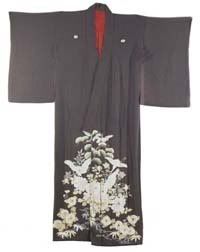
During the Heian period in Japan, the color red was strictly for the rich and royal. Laws prohibited regular people from wearing red, so they rebelled by wearing red undergarments that the authorities couldn't see. To this day, some Japanese kimonos are lined in red, a hidden burst of color, daring and sex.

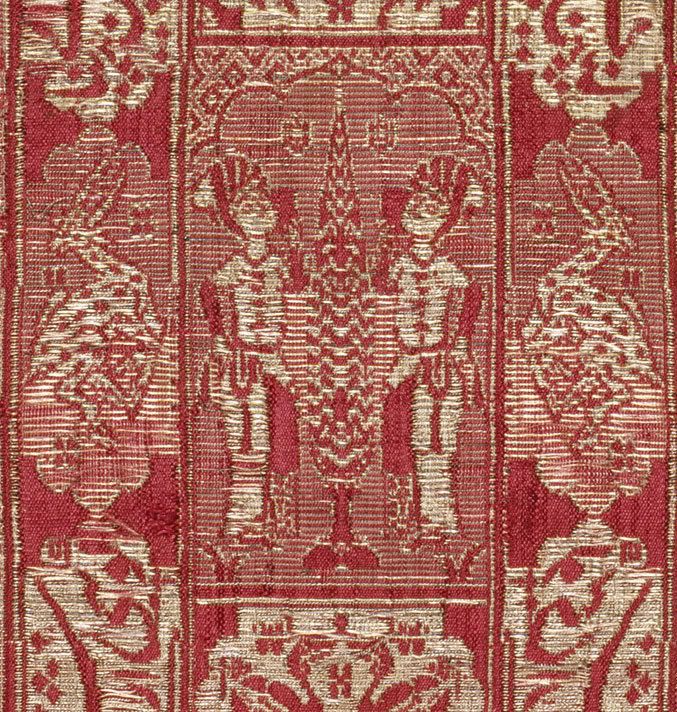
This is one of the many things I learned about the color red during my excursion to the Textile Museum on Saturday. "RED" explores the meanings and significance of the color across cultures and time. Until the invention of commercial dyes, red was one of the hardest colors to create organically. It was rare and used only at special occasions, be they weddings, births or death. After the invention of chemical commercial dyes, red did not lose its appeal, and the exhibit includes modern examples of a stunning ball gown, a tiny AIDS ribbon lapel pin, and a collection of ceremonial presidential photographs.

The exhibit is not large -- it takes up only one and a half rooms -- but the collection has pieces dating back to 900 BCE, and spanning every continent, including Persian, Chinese, Vietnamese, Japanese, Afghan, Mexican, Macedonian, Peruvian, Turkish and American textiles, among others. One of my favorite pieces, a tiny, detailed piece of stitching from Persia depicts an entire folk tale of the love between a man and woman separated by a mountain. It's a small, red, 16th century comic book. A large and beautifully intricate Chinese collar was worn by a bride on her wedding day, where it was custom for the bride and groom to dress like the Emperor and his wife on that one special day. The collar, lined in a pale, faded red, is worthy of the Emperor's wife for its beauty and intricacy.

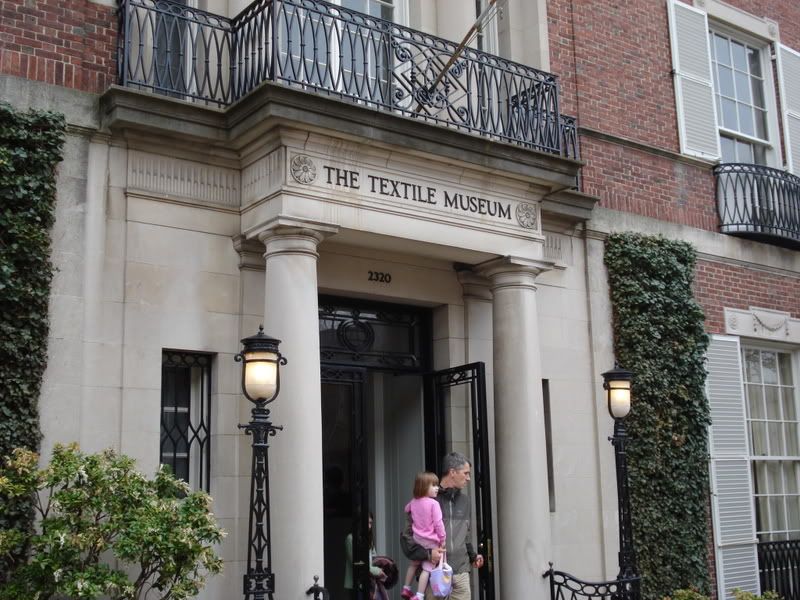
The Textile Museum of DC is the only museum in the US devoted to the textile arts. Considering its the only one of its kind, and that it's been around since 1925, you'd think I'd have heard of it. But tucked away in Kalorama at S and 23rd, in a stately but otherwise unremarkable brick house, I had no idea it even existed. Only while leafing through a booklet of area galleries did I run across it's listing.


"RED" is its current exhibition, and they were in the process of setting up an exhibit of tent bands from Central Asia, which we could only see from around corners but looked equally interesting. In addition to its exhibitions, the Textile Museum features a textile learning center, where touching and feeling is encouraged (it is strictly forbidden to touch the textiles on display). It explains the language of textiles, where different materials come from, how dyes are produced in nature. It shows the difference between weaving pattern into cloth, dying pattern into cloth, or putting the pattern onto the cloth with embroidery. Through the interactive exhibit (which I imagine children might really love), the participant learns about the cultural significance of textiles, and how we learn from cultures by how they make their textiles, the colors, patterns, techniques and materials they use.

The museum also has a really wonderful gift shop, with unique bags, scarves, ties, and dolls from around the world. Excellent gifts for those who have everything.

The museum is free, though a $5 donation is suggested.

Saturday, March 10, 2007

Thing 8: An Afternoon at the Galleries

And to think, Wednesday it was snowing and I was yearning for a hot toddy. I woke up late this morning and it was a glorious Spring day! Sun's out, a cool breeze is blowing and I could leave the house without coat or scarf. The perfect sort of day for a leisurely lunch and a tour of some local art galleries, which is exactly what I had planned with my friend Emily.

Emily owed me a lunch from a previous occasion, and she picked DCHot!. Being a sucker for a good toasted sandwich, I was happy to try this small place, located on P Street just west of Dupont Circle. I had the "Kansas Roast Beef," which boasts some of the tenderest roast beef I've ever had on sandwich, and a creamy horseradish sauce. The shop is cute, with a kitchy collection of old DC license plates on the walls and a variety of old timey Coca-Cola advertisements. After lunch, Emily and I crossed over to the east side of Dupont to explore some of the art galleries tucked away along 14th Street.

When I first arrived in DC, there wasn't a whole lot going on 14th Street. There was the Studio Theater and the Black Cat, but this historically black commercial corridor hadn't yet fully recovered from the riots in 1968, when it was burned and gutted. Then the Whole Foods moved in at P Street, between 14th and 15th. This precipitated a rapid revitalization and gentrification of the neighborhood. Restaurants, bars, funky little shops and very expensive furniture stores now line 14th Street, as well as art galleries.

Joseph McSpadden: Flesh and BoneWe stopped first at the Irvine Contemporary, a spare white space at the corner 14th and P. The exhibition, "Joseph McSpadden: Flesh and Bone" was my favorite of the three collections we saw. McSpadden's works were of two varieties: thick slabs of oil paint the circumference of quarters stacked on top each other into small peaks and valleys, or five foot long waterfalls of dried oil paint, each color its own fiber, dripping down and pooling at the bottom.

The artist sums up his collection by stating: "My work confronts our expectations of painting, questioning how the object is animated and who is responsible for animating it." I love the idea of re-imagining oil paint as a 3D medium, rather than relegating it to its traditional two dimensional function; making sculpture with it. The colors were earthy and fleshy and the sculptures so appealing, I had to remind myself not to touch them.

Joseph McSpadden: Untitled Panel 2

Just up the street, we next visited the Randall Scott Gallery. They currently have a show called "All Things Said, In Motion," featuring the work of five artists who use motion in their work. ThisTwo of the pieces in Rob Carter's beautiful Mauritius series. gallery had a lot of multimedia works, including an installation representing a deconstruction of grass growing in a field, complete with little boxes of sand and wind blowing long, single strands of grass. For $4,000 you can own Dane Picard's dvd, "Cheetah Hands," what he calls a "hand mosaic" that animates the outline of a cheetah running using only hand gestures pieced together in squares. Emily's and my favorite was probably a series of really beautiful photographs taken by Rob Carter at sunset in Mauritius. The colors were so vivid and vibrant, the images calming and still. The series of the four of them was beautiful put together, and made me long for a higher level of disposable income.

Finally, we visited the Adamson Gallery across the street and in the Donald Sultan: Smoke Ring #1same building as Veridian, a restaurant I'm itching to try. This show featured an eclectic mix of artists and mediums, including cast resin on wood that looked like those drawings of skin cells in high school biology text books, and a photograph of lightning against a red sky with an 8 x 10 mirror on one side and titled "The Dalai Lama." My favorite in this collection, without question, were two 3' x 4', black and white photographs of smoke rings. The detail of the smoke curling, curving and dissipating is truly beautiful.

Thus concluded our afternoon touring the diverse collection of art galleries on 14 street. I'm well aware that both Dupont and 14th Street are brimming with hidden galleries, and this will probably be Donald Sultan: Smoke Ring #2the first in a series of gallery tours. We just couldn't bear to be out of the nice weather any longer though, and Emily and I headed down the street to Dupont Circle to while away the afternoon reading in the sunshine.