Find party invitations for any occasion at eInvite.com. Personalize, preview, and order your invitation instantly.
Showing posts with label Walking Tour. Show all posts

Monday, June 15, 2009

Thing 157: The Franciscan Monastery of the Holy Land in America


"This fossilized snake in the marble is over 400 million years old -- sorry if there are any Creationists on the tour," our guide, Claude told us. Which seemed like a kind of a weird thing to say, because on a tour of a monastery, at the foot of a statue of Mary, Mother of God, it seems safe to say there will be one or two Creationists around. Does the Pope know there's a 400 million year old fossil in this church? And if so, what does he make of it, exactly?


That was but one of many of the bizarro moments from my tour of the Franciscan Monastery. You may recall that I only recently learned that this place existed when I toured Brookland earlier this month. I was so taken with the place that I immediately set up a return trip, complete with picnic, to spend some more time on the grounds and have a chance to tour the church and catacombs.

We had a picnic of a half dozen people, and we ended up setting up across the street, in a large patch of shady grass, so as not to disturb the people that might be there for more sacred purposes. On Sundays, there are tours of the church at 1pm, 2pm and 3pm, and I hopped on the 3pm tour.

The church is stunning -- gold leaf and stained glass and marble, an elaborate enameled covering over the dais, ornate statues and wood carvings. It reminded me of when I was traveling in Prague by myself, just sort of trapsing through the city and ducking my head into random churches, when I poke into one of them and everything was shiny and golden and elaborate. The unexpectedness of the beauty of this church, tucked away in Northeast DC, is really awesome (as in, inspiring awe).


Our tour guide, Claude, swept into the waiting area and abruptly began the tour. Short and rather stout, with a short, greying beard, Claude was dressed like a British Colonial guard in India circa 1880, head to toe in white with a red sash. He was very knowledgeable and good natured, but quite abrupt, and had the straight-ahead, rehearsed mannerism of someone who has given this tour, many, many times.

He took us through the church, explaining that this is a replica of a the Shrine of the Holy Sepulchre in the Holy Land, complete with replica tomb and replica...catacombs. That's right, the catacombs I was so looking forward to were...fakes. Basically, we went underground, through a dark tunnel with indentations that, if these really were catacombs, would have had dead bodies in them.

After the tour, I spent some time in the rose garden and walking through the cloisters, taking in the bright and shiny mosaics of scenes from Jesus' life. Everything was blooming and the grounds were bathed in sunshine. It was a really pleasant afternoon, and if you haven't visited yet, I really encourage you too. But don't expect any real catacombs.

Friday, June 5, 2009

Thing 155: The Notorious Scandals of Dupont Circle


The final tour I took over WalkingTown DC weekend was the Notorious Scandals of Dupont Circle tour. I was not the only person to have this idea. Over 200 people showed up for this tour which was...too many. Although the tour was still fun, it lost a good deal of its charm by virtue of having to do battle with other people in order to get close enough to hear our guide. Even with that obstacle though, I learned the following things:
  • In the late 1910s, an anarchist attempted to blow up a member of the Cabinet by strapping explosives to his body and then ringing the doorbell. Unfortunately, on his way up to the house to ring the door bell, the young man tripped on the sidewalk and blew himself up -- and what a powerful explosion it was! Paul, our guide, read us the newspaper account, which was mighty gruesome, including that the man's spinal column flew across the street, broke an upstairs window, and landed by the bed of a student trying to take a nap!
  • The Hope Diamond belonged to a woman who lived in Dupont Circle (the house that is now the Indonesian embassy, in fact) -- her family was so rich that seemed to have just bought it on a lark, and there are pictures of her swimming in it, and accounts that she would attach it to her dog's collar before taking him out for a stroll.

  • And speaking of diamonds, that lady from the Titanic movie? Rose? Based on a DC resident. She was way ahead of her time, writing and lecturing on how women should be their own people and make their own living. She lived on New Hampshire Avenue, and was coming back from Europe aboard the Titanic. When the Titanic hit the iceberg, she found a lifeboat that was being captained by a very inept male crew member -- she and another woman took it over and steered them towards rescue.

  • DC also has its own "Schindler" who saved a bunch of Jews during the war, but didn't get a movie made about him so isn't as famous. And of course, I didn't take notes during this tour, so I am unable to bring his name to light even now. But, if I recall, he saved 60,000 German Jews by getting them US visas in a hurry.

  • We stopped along the block of Q Street between 17th & 18th, right in front of a man's house who was just sitting on his front stoop, drinking coffee and reading the Sunday paper. Suddenly, 200 people swarm around his house, as our guide announces to us that this block is famous for murder and mayhem. In fact, in front of this particular house, a man was killed with nothing but a slingshot. Nice relaxing Sunday for that home owner, I imagine.

  • DC had its very own slasher -- like Jack the Ripper. This person would break into people's homes, and slash his victims ruthlessly. This went on on and off for six years until he was finally apprehended. How could this go on so long? His victims were sofas, and other pieces of furniture, and so he was pretty low on the police's priority list.

  • Dupont Circle originally had a statue of Admiral Dupont in the center of it -- just as Logan or Thomas or Scott circles have statues of Logan or Thomas or Scott. Except apparently, Admiral Dupont was a pretty terrible admiral. His statue was mocked when it stood in the circle, and eventually, his family took it down and moved it to the family estate, and commissioned the now-beloved fountain to stand in its place.


Our tour was led by Paul Williams of Historic Dupont Circle Main Streets, who literally wrote the book on Dupont Circle. He was as surprised as the rest of us by the sheer turnout for the tour, but stayed in good spirits and projected his voice just as much as he could. And he clearly took delight in all the scandals and murder that he told us about, as did the 200 of us listening, and the odd homeowner who might have learned a little something new about his home that day.

Thursday, June 4, 2009

Thing 154: Walking Tour of Brookland

Continuing with my recap of WalkingTown DC free walking tour weekend, I got off at the Brookland/CUA metro stop for a walking tour through the Brookland neighborhood. This was the second time getting off at that metro stop in the entire ten years I've lived here, and the first time was to go to a craft fair at Catholic University. So I was really going into this tour without any idea of what I might learn or see or find.

What I found is a highly residential, very diverse, suburban feeling neighborhood, with a mix of houses going back to the early 1900s up to modern architecture. Our guide, Ed, had lived in the neighborhood for seventeen years and was proud to show us the homes of any resident, past or president, who had even a tenuous claim to fame.

We started out tour by seeing the original Brooks mansion, which lent Brookland its name once the property was divided and sold. In the 1840s, the Queen family had built their daughter and her new husband, Mr. Brooks, a mansion on a hill, sitting on a hundred or so acres. In the 1880s, the land was partitioned and sold. Because it was not sold to a developer but rather sold as individual lots, there's no uniform look to the neighborhood -- everyone built whatever kind of house they wanted to. In addition, because the lots were sold individually, it was a more hospitable neighborhood for African Americans, and the neighborhood has a rich history of prominent African Americans as residents.


The neighborhood also has a rich Catholic history. Not only is Catholic University right across the train tracks, but there are numerous Catholic schools and churches in the neighborhood. In addition, there is a Franciscan monastery up the hill that is truly stunning.

Ed led us up the hill (past a park that used to be a Civil Was fort, but now apparently has really excellent sledding terrain in the winter) and once we'd entered the monastery, gave us ten minutes to explore on our own. The monastery is completely breathtaking.


Inside city limits, tucked away in the middle of a residential neighborhood, is a huge monastery, with a gorgeous rose garden, fountains, cloisters lined with vibrant mosaics, and the "Ave Maria" in every language of the world. That's all I had a chance to see in ten minutes, but I already have plans to go back and spend an afternoon there, so I will report back shortly on what else there is there. Ed said there were catacombs, which I'm looking forward to. But the fraction that I did see completely blew me away, and made the trip out to Brookland well worth it.

I do have a major remaining question about Brookland -- aside from frolicking through the monastery and gardening in your enormous corner lot, what is there to do there? We passed through their commercial strip, but it looked mostly like chains or takeout counters. What am I missing? If you have a favorite bar, restaurant, museum or activity in Brookland, leave it in the comments. I am intrigued by the neighborhood, but not sure what else might be there.

Two years ago: The smoky goodness that is Rocklands BBQ.

Wednesday, June 3, 2009

Thing 153: Walking Tour of Historic Logan Circle

I live in Logan Circle. I shop there, I eat there, I've worked there -- in other words, it's my home base. Which is why I'm so embarrassed that I knew virtually nothing of the history of the neighborhood! Did you know that General Logan started Memorial Day? Or that Logan Circle was originally called Iowa Circle? And that the Iowa Circle neighborhood was called "Hell's Bottom" in the late 1800s because it was that bad? Or that Mary McLeod Bethune used to live in the neighborhood? Next to a museum for confederate soldiers?

I learned so much on this tour.
We started the tour in Logan Circle itself, with our tour guide Tim, a small and good-humored man with the faintest of mohawks. He started by explaining to us how Iowa Circle fit into L'Enfant's grand plan for the capital, as one of the points of a triangle between Logan Circle, Dupont Circle and the White House. The circle was planned to be residential, and is now the only remaining purely residential circle in the whole city.

Almost from the get go, Iowa Circle was not a great neighborhood (hence the Hell's Bottom nickname), but then in 1968 it was pretty much burned to ground or otherwise destroyed in the riots following MLK Jr's assassination. After that, it's been on a slow but steady rebuild, that was greatly accelerated once Whole Foods opened up on P Street.

We walked from Logan Circle to Naylor Court, to learn a bit about residential alley life after the Civil War, and then contrasted that by looking at the SoLo Piazza building at the corner of 13th & N, as an example of the newer architecture in the neighborhood.

We learned that the Washington Plaza Hotel was designed by the same man who designed the Fontainebleau Hotel in Miami (and now that he mentioned it, I do see a strong resemblance), and across the street we learned about the rival Lutheran churches, as well as the history of the N Street Village.
Perhaps most interesting was just up the street from there, where the Mary McLeod Bethune House has been converted into a historic museum that gives tours! (It's on the list now, so keep an eye out for an upcoming Thing.) Apparently, when Mary McLeod Bethune was in DC, she lived in my neighborhood, out of the top floors of house on Vermont Ave, and on the bottom floor were the meeting places of the National Council of Negro Women. Then someone else on the tour group piped in that the enormous house two doors down from Mary McLeod Bethune's had been a rest home for Confederate veterans, and then was converted into a museum of Confederate history, which flew the Confederate flag! They must have made for uneasy neighbors.

We went down to the retail heart of Logan, P Street between 14th & 15th, where we got a peak at the original Shepard Fairey Obama portrait, and then stopped on 14th Street to talk about the Studio Theater, and the old Automobile Row of the 1950s. Have you ever wondered why so many buildings along 14th Street (like Posto, for example) have those enormous, open, first floors? They were automobile showrooms in the 1950s, and the buildings have all been deemed historic buildings since then, so they can't be redeveloped into less awkward spaces.

The tour ended back in Logan Circle, with the career of General Logan himself. General Logan was a staunch anti-abolitionist, until his experience fighting alongside black Union troops changed his mind and he became a strong advocate for civil rights. After the war, he was elected the Senator for Illinois, and had a townhouse actually on Iowa Circle, which would later be named for him. When he was re-elected to the Senate, several thousand black DC residents gathered in the circle to congratulate him, and he invited every single one of them into his home so he could have the honor of shaking their hand. Apparently, it took well into the night.

This is a brief (well, I tried to keep it brief) overview of the tour -- if you're interested in learning more about the neighborhood, I highly recommend taking the tour when WalkingTown DC comes back around next fall, or get in touch with the Logan Circle Community Association.

Coming up, I tour Brookland, and am way impressed by a neighborhood I knew nothing about!

Related: Bike tour of the Anacostia Riverwalk, Before There Was Harlem..., and North by Northwest.

Monday, June 1, 2009

Thing 152: Bike Tour of the Anacostia Riverwalk

If any of you out there are following my Twitter feed, you'll know I spent pretty much my entire weekend on one tour or another. Yes, it was the semiannual WalkingTown DC, which gives locals and tourists alike the opportunity to participate in over a hundred free walking and bike tours. This event is held in the spring and in the fall, and organized by Cultural Tourism DC, and I urge all of you to take advantage of this opportunity!

I started my WalkingTown weekend at 9am on Saturday morning at the entrance to the Southwest fish market, bike in tow. I was there for the bike tour of the Anacostia Riverwalk, along with about twenty other early birds. This tour is put on by the DC Department of Transportation (or DDoT, or "d.") and was actually led by the head of DDoT, Gabe Klein. Allow me a moment to geek out, but how cool is that? If you read this website, you'll remember that Gabe Klein was a bold and progressive choice for the job, having come off of a four year stint as regional VP of ZipCar, and as an advocate for transportation that might not necessarily begin and end with the personal car. And now here he was, in bike shorts and bright yellow biking shirt, ready to give the twenty of us his own guided tour of the Anacostia waterfront.

After giving us an introduction and an overview of the plan to rebuild the Southwest Waterfront area, we cycled in a pack down to the Titanic Memorial, and then east to the Nats Stadium. At the stadium, Klein, with help from three other DDoT employees, talked about the transportation issues surrounding the building of the stadium, and also the colossal engineering project that was the lowering of the South Capitol Street Bridge.

We continued on to the new USDoT, which stands next to the Navy Yard, and they spoke about the grand plan to connect the stadium all the way through the Navy Yard and beyond with new bike trails, hopefully easing some of the commuting congestion for the 20,000 expected new federal workers in the area. Klein mentioned that he's also looking at remaking the bridges, adding extra bus lines down M Street, and hopefully extending the upcoming street car system into the area, along with encouraging mixed-used developments so that people can live, work and play all within walking distance.

After this stop, I get a little hazy, geographically speaking, on where we went next. I know that we rode along a trail that took us next to a boat house where there were crew races:


And then over some railroad tracks and around and behind RFK Stadium, to what I think was Benning Road, where there was a farmers' market. We took a ten minute pause here to use restrooms and refuel, as needed.


From there, we crossed the Anacostia to its east bank, and then rode for several miles along the river, past a roller skating rink, past playgrounds and picnics and people fishing, seeing the crew races and the Navy Yard and the Stadium from an angle that I've never seen before. We met up again at Poplar Point, where one of the DDoT employees talked about the huge mixed-use development they envision some years into the future, with plenty of park land and new housing, retail and work space, all a few steps from the Anacostia Metro Station.

And from there, we went over the South Capitol Street bridge, and back to the fish market. In all, the ride took three hours, I saw parts of DC I've never seen before (and frankly, I'm not sure I can find again), and got an inside look at the vision behind a lot of the development projects that will shape the future of DC.

From there, I had to zip back home to shower and eat before heading to the next tour...Historic Logan Circle.

Related: Before There Was Harlem and North by Northwest

Tuesday, May 22, 2007

Thing 37: Spy Tour

Thing 37 marks one tenth of my quest to do 365 fun DC things. It's taken me about three months to get here, and in that time I've pushed and stretched myself to look for things I might never have done. Favorites include the National Building Museum, Ceiba, a Wizards' game, and Urban Dare. As always, I encourage any of you out there to leave a comment with suggestions of things to do next -- what are your favorite activities or places that I might not know about? Send them my way! Readers have already suggested an Argentine gelato place, the revolving restaurant in Crystal City, and Famous Luigi's. They are all on my list, and you'll be reading about them in the coming months.

Sunday afternoon, I met up with a small group at the corner of Massachusetts and Wisconsin, across from the National Cathedral, to take a spy tour of the neighborhood around the Russian embassy. Presented by the Spies of Washington Tour company (and by "company" I mean "one woman"), this particular tour of Glover Park is named the "North by Northwest" tour. It is led by the one and only tour guide at Spies of Washington, a retired Air Force intelligence officer named Carol Bessette. Something of a pioneer herself, Carol originally joined the Air Force for what she thought would be a three year tour. Then, when she decided that her future was in Air Force intelligence, she was told that women could not be intelligence officers. She ultimately found a way around that by having the air force send her to graduate school, and served over 25 years as an intelligence officer. Which means she knows a lot.


Unfortunately, she can't divulge most of it, only that which is available in the public record. But there is some pretty interesting stuff out there, and it is great fun to learn about intrigues and espionage that occurred in regular old apartment buildings. Take, for example, the Alban Towers apartments, which Carol talks about at the start of the tour. In the 1930s, the Japanese embassy kept an apartment there as a residence for the Ambassador. American intelligence wanted to rule out that they had a secret radio in the apartment, and set up a long term operation where they would flick the lights or cut the power briefly over the course of several months. Then one day, they cut it entirely, and sent two agents dressed as repairmen to seek out the problem in the apartment. After a thorough search, they learned that there was no radio in the residence, and it had to be located in the embassy itself.


Intrigue at the Russian Embassy
Carol takes us down Wisconsin to the Russian Embassy, an enormous compound about three blocks wide and three blocks long, its white, imposing block building towering over an iron gate. The tour comprises primarily of a walk around the perimeter of the embassy, with stops at mail boxes or storefronts to tell various stories of espionage or failed spying. We learned briefly about Robert Hansen and his signal site -- a mailbox in Georgetown he would make one single chalk mark on as a signal to the Soviets that he would be making a drop at a prearranged time and place. The Soviet diplomat would then stroll the .8 miles down the hill, check out the mailbox and report back to his superiors. Secrets would be spilled.


The side view: the embassy's consular entranceThere's the story of Vitaly Yurchenko, a KGB officer who defected to the US during the Cold War. The hypochondriac Yurchenko thought that he had stomach cancer, and wanted to die in as a hero in America with top quality medical care. When it turned out he was perfectly healthy, he escaped his CIA handler while dining at the now defunct Au Pied Du Cochon in Georgetown, hoofed it up Wisconsin Ave, and redefected back to the USSR.


She tells us the story of a mysterious package, thrown over the wall of the Russian Embassy containing classified documents and instructions on how to get more where that came from forIn the back of the embassy, a private path that runs along side.  Under our feet might be the mysterious tunnel under the embassy! $30,000. And she speculates on where the tunnel below the embassy may lie, which Robert Hansen warned the Soviets about when they were constructing the embassy. The Soviets had already discovered that Americans had built a tunnel beneath their embassy in Berlin to tap into their phone lines, so it was not out of the realm of the possible. Then again, the tunnel was never found, so it may simply be a spy myth.


Carol is extremely knowledgeable and well read on the material, she is friendly and grandmotherly, and she relates many of the neighborhood's stories to her own experiences with colleagues or giving tours. She refers to young women "entertaining" men in their apartments or hotel rooms, with a sort of faux modesty that is very endearing. Mostly, she tells a good story, and with such a juicy and romanticized topic as spying, it is great fun to listen to.

Carol will resume her walking tours in the fall.

Wednesday, May 16, 2007

Thing 35: Embassy Open House Day

Good Friend David and I have a thing for embassies. It is nerdy and embarrassing in the extreme, but I figure it was bound to come out eventually, so here we go. We love embassies. We group them by world geographic regions, and then walk to them. On weekends. When they're...not open. Then we take pictures out front of them. And we learn fun facts about those countries. Then we cook something from that part of the world, or visit a restaurant that celebrates that particular cuisine. We've been doing this very slowly over the past two years. Our goal is eventually to have visited every embassy in DC. I am hanging my head in shame as I type this.

Anyway, you can imagine our utter glee and excitement when I saw a sign in the metro for EU EMBASSY OPEN HOUSE DAY! This is an international affairs nerd's fantasy made real. There was even a "passport" to print off from the website that you could get stamped at every embassy you visited! Just a word of warning, we took a lot of photos over the course of the day, so this entry looks a lot longer than it is. Don't give up!

Last Saturday, at 10:00 am sharp, GFD and I met in Dupont Circle and began walking up Massachusetts Avenue to tour as many embassies as we possibly could in one day. We began with the Embassy of Luxembourg:

The Embassy of LuxembourgIt was already packed full of people, even though it had only just opened. Throughout the day, GFD and I remained astonished at how popular this event was. We were pretty sure our love of embassies was unique. And sure, we're probably the only ones who walk for miles to take our pictures in front of embassies that aren't open. But apparently, hundreds of people are happy to spend there sunny Saturday touring European embassies. Many of them had long lines to get in all day.

The embassy of Luxembourg is large and spacious, with a beautiful ceiling in the main conference room:
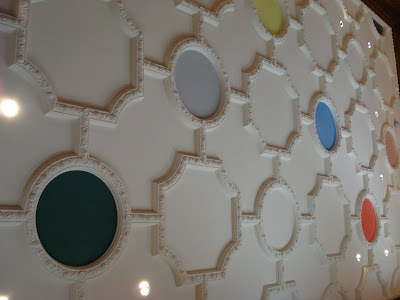
The Ceiling at the Embassy of Luxembourg
Next stop: Bulgaria. The Bulgarian embassy had a sampling of wine (not very good), feta cheese (very good), canapes that didn't look particularly Bulgarian, and a traditional Bulgarian folk band, which GFD and I liked a lot, but comes across kind of annoying on the video.


Bulgarian Canapes
A Bulgarian Specialty? Cheese Cubes with Cocktail Olives


Then it was up the street to Greece. We were hoping for retsina and spanikopita. Instead, they had a very Greek buffet of potato chips, pretzels, and Coca Cola. They did, however have a table that featured all kinds of Greek products, but you were not invited to take those home with you.

Greek Products


Next stop, to Cyprus. The embassy of Cyprus was a small place, the main attraction was a travel movie being broadcast in the main room. There were, however, snacks. Coconut candies, and strange fig and rose flavored gummies and a large platter of halloumi cheese samples. Halloumi is salty and firm, like feta but less creamy. Next to the samples are pamphlets with recipes featuring halloumi cheese, which I cannot wait to test out.

Cypriotic Coconut Candies.  Yum!


Cypriotic Fig Flavored Gummies.  Ew!


Me, with a Knight of MaltaAt this point, we transitioned from Massachusetts Avenue to Connecticut Avenue, to see the Maltese embassy. It is a tiny townhouse, not much to tour. We waited downstairs with one of the Knights of Malta until the group upstairs left and made room for us. When we were finally allowed upstairs, we saw why it had taken so long -- our group of about twenty was herded into the Ambassador's office, where he and his wife greeted us, shaking hands. Then the Ambassador himself gives us a brief tutorial about his country of origin -- its colonial history, exports and industry, language and culture. And no, the Maltese Falcon has nothing to do with Malta. Someone asked.

As we left the Maltese embassy, the shuttle bus was just stopping, and we hopped on for a ride up Connecticut Avenue to the Slovakian and Austrian embassies. The Slovakian embassy was airy and spacious. They were serving some delicious cinnamon strudel.
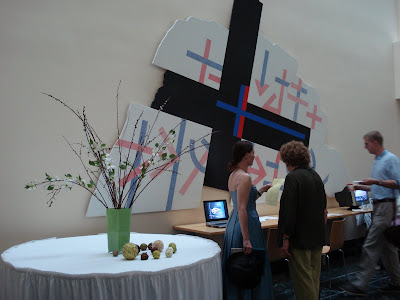
The Slovakian Embassy
Slovakian Ceramics
Across the way was the Austrian embassy. Once inside, in the main foyer whose centerpiece is a giant gold statue of a violinist, there was a line for Austrian coffee and line for a tasting of Austrian wines. We chose the wine line (surprise!), which took a very long time because each group of about 12 were tasting eight wines. Luckily, GFD and I began talking to a very nice couple in line behind us...who turned out to be the parents of the babysitter of one of my best friends in college. The Austrian Embassy
Austrian Wine Tasting
Two of the wines turned out to be so good that GFD and I ordered a mixed case with both of them, to split between the two of us. Effective marketing!

Then we took the shuttle down to Spring of Freedom Street in Rock Creek Park, to visit the Czech and Hungarian embassies.

Czech Yourself Before You Wreck Yourself


I'm Hungary for Paprika CreamThese embassies were about to close as we were visiting, but we had just enough time for a free Pilsner Urquell, to pose with a woman in costume, and to make fun of the Hungarian's love for industrial size tubes of paprika cream. (And before I hear from angry Hungarians, that bit is a joke. I've never had it, but GFD assures me that paprika cream is actually really good).

At this point, the logistics of the event kind of broke down. It was 2pm, and the Czech and Hungarian embassies had closed for the day. The shuttle bus arrived, but it was already full. No one was going to get off here, because both embassies were already closed. And there were about 50 people waiting to get on the bus. The buses were running about every 20 minutes. So GFD made the impulsive and poorly thought out idea to walk back to Dupont.

After half an hour, when we still hadn't even passed the zoo and were fantasizing about what we wanted to eat for our very late lunch, we saw the error in our way. We hailed a cab in the middle of the parkway and asked the driver to drop us off in front of Potbelly Sandwich works on Connecticut Ave.

Quenched and sated, we strolled over to the Slovenian embassy, which was displaying posters of its brand new Euro coins and brochures of half naked men and women covered in mud and/or chocolate, entreating you to visit the lovely spas of Slovenia.

Slovenian Euros

Finally, worn out, tired, dusty, and not a little sore, Slave Driver David made me walk over to 23rd and M Street to visit the European Commission. There were a lot of information booths set up, about the environment, European police, the Euro, food safety etc, but we were so worn out that we couldn't absorb too much information. I did pick up a pretty neat calendar about European Union foods though.
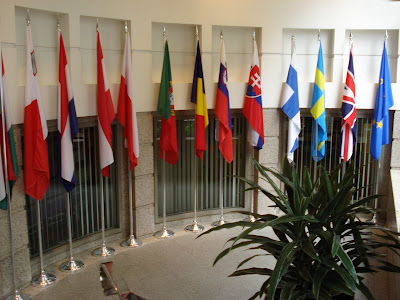
The European Commission
It was around 4:00 by now, and I was in some serious need of a nap. All in all, we ate some really tasty and exotic foods, were exposed to music from other cultures, picked up about 8 lbs of promotional materials, learned some new recipes for halloumi cheese, ordered 12 bottles of cheap and delicious Austrian wines, met the Maltese Ambassador, and desperately want to visit Slovenia on our next vacation.

Where else in the world but DC could all this have happened in one day?

My Passport


Did you enjoy reading this? Subscribe to my RSS feed, or get new posts delivered right to your inbox!

Tuesday, May 1, 2007

Thing 30: "Before There Was Harlem..."

Duke Ellington Mural on U Street "The who's who of America passed through this neighborhood," our tour guide will tell us over and over during out two-and-a-half hour walking tour. And as she takes us along U Street and into Shaw, you realize, she's absolutely right. Duke Ellington, Thurgood Marshall, Bill Cosby, Louis Armstrong, Ella Fitzgerald, Lena Horne, Diana Ross, Cab Calloway, Langston Hughes, Dr. Charles Drew, Coach John Thompson, and all manner of black lawyers, doctors, writers, musicians, politicians, activists and intellectuals. They were all either born, educated, or made their livelihoods on U Street and in Shaw.

On a perfect, sunny Saturday morning, I meet a small group at the 13th Street exit of the U Street metro stop to take a walking tour of the neighborhood, led by Sandra at Washington Walks. Sandra turns out to be a somewhat strange guide -- knowledgeable but disorganized. Her speech is dotted with repeated phrases ("the who's who of America," and "we're going back 140 years," are mentioned more times than I can count), and though I'm sure she's given the tour many times before, her explanations meander and she frequently misspeaks. However, her point is a good one -- before there could be a Harlem Renaissance, those artists and intellectuals had to pursue a rigorous education. And so before they went to Harlem, they came to Howard University in the Shaw neighborhood, the most important of the historically black colleges and universities in the nation.

Our tour begins at the corner of 13th and U with a view of the Lincoln Theater, Ben's Chili Bowl and the mural of Duke Ellington on the side of the True Reformer Building. Sandra sets the stage for the tour by playing Duke Ellington's Take the A Train from a small stereo in her canvas bag, and tells us about the days before integration, when blacks were not allowed to shop downtown or enjoy the entertainment. So they spent their free time in Shaw, seeing movies at the Lincoln Theater or live acts at the Howard Theater. "We're going back 140 years," she says as she explains that the Shaw neighborhood is named for Colonel Robert Shaw, the white Civil War colonel portrayed in the movie Glory, who led an all-black unit of the Union Army. After the Civil War, thousands of black Civil War soldiers settled in this neighborhood, creating the largest urban black population in America prior to World War I.

Our next stop on the tour is the True Reformer Building, at 12th and U. Historically, Duke Ellington played his first show here. Today, it houses the museum that goes with the African American Civil War Memorial located at 9th and U. We spend about a half hour in there, looking at old prints of black Union troops entering Richmond, photographs of Frederick Douglas' two sons in their Union uniforms, bills of sale of slaves. We watch half of a longer documentary about black soldiers in the war. The regular curator is apparently not there today, replaced by a young woman that does not know Sandra, and the two women seem uncomfortable in each other's presence, trying to out do each other for knowledge of the Civil War. We leave the museum and walk towards the Thurgood Marshall Center.

I had never been to nor heard of the Thurgood Marshall Center, despite its location at 12th and S St, NW. A former YMCA, this historic building is primarily a community meeting space, but also houses a small exhibit about the historic social life of the Shaw neighborhood. As Sandra explains, during segregation, blacks were not allowed to stay at white hotels, and there were no hotels at all for blacks. They were relegated to boarding houses, and places like the Y. Famous entertainers and athletes stayed here because there was nowhere else for them to stay.

The Y also served as overflow housing for Howard, and they have a sample dorm room stillLangston Hughes' dorm room, Thurgood Marshall Center in Shaw set up for visitors to look at. Langston Hughes once lived in a room just like this. Langston Hughes was a really important poet for me when I was in high school and it was completely humbling to see his college dorm room.

Next stop on the tour: the former Whitelaw Hotel, at 13th and T St. This historic hotel is now a low rent apartment building, but was once the first hotel in the District built for and by black people, to accommodate first class guests who might not want to stay at the Y or another boarding house. It was built in 1919 by John Whitelaw Lewis, a wealthy African American who founded the Industrial Bank of Washington. "The who's who of America" passed through this hotel in its day.

After desegregation, when the white hotels downtown were opened up to all guests, the Whitelaw fell out of favor and declined. By 1977 it was in serious disrepair and was closed by the city. Sandra took us inside for a look at the dining room's original stained glass ceiling. When the building caught on fire in the '80s, one of the locals from the neighborhood took out the original ceilings to save them from ruin. They are now back in the building's main community room, one representing fish and the ocean, the other representing fauna and the forest.

Duke Ellington's childhood homeDuke Ellington's childhood home is at the end of the street, but we are now running behind so Sandra simply tells us the address and then scoots us towards our final stop on the tour. After the tour I seek it out, a nondescript, red brick building, two stories with a small front yard.

We end the tour at the African American Civil War Memorial, at 9th and U. It depicts three African American Civil War Memorialsoldiers and a sailor, all African American, on the front side of the bronze statue. On the back, in the hollow, it depicts their homecoming. It is surrounded by two large granite arcs, with over 200,000 names carved into them, the "Wall of Honor." These are the names of all the soldiers who fought in the all-black units of the Union Army and Navy.

Sandra leaves us by pointing out the outline of the Howard library in the distance, reminding us that this city, this neighborhood, and this university drew a large, vibrant community of African American artists, intellectuals, professionals and business owners, sustaining the community after the Civil War and through the civil rights movement.
African American Civil War Memorial