Find party invitations for any occasion at eInvite.com. Personalize, preview, and order your invitation instantly.
Showing posts with label Books. Show all posts

Friday, May 15, 2009

Thing 150: Politics and Prose

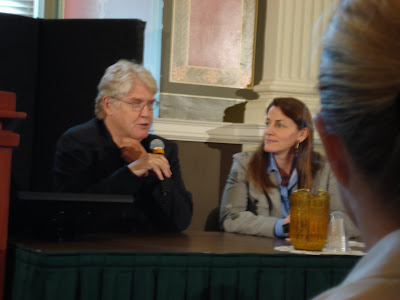
"We're going to have a reading tonight," Colson Whitehead told those assembled. "It will be fun, edifying, and very, very post-black." He gives the final two words grave emphasis. The audience laughs knowingly, because they all read the New York Times Review of Books religiously.

Welcome to nerd paradise. I am right at home.

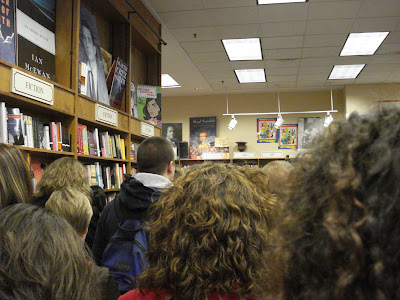
Politics and Prose is indeed a paradise for bookworms and intellectuals, an oasis in the dry landscape of chain bookstores. This is among the last of the feisty breed known as the independent bookstore, and one of the reasons they stay relevant is by hosting really excellent authors of both fiction and non, on a regular basis. They also have a great, great selection of books (hard for me to not buy everything I lay my eyes on) and a cafe downstairs. I can't speak personally for the coffee or food, but the coffee in the audience smelled amazing, which is a good sign.

I was excited to be there to see Colson Whitehead, and author I much admire, in particular for his first book, The Intuitionist, which I still think about when I'm in an elevator. In a rather slim novel he spun an alternate reality in which elevator inspectors formed a brotherhood, an exclusive clique, and the two competing schools of inspection were at constant odds. It sounds convoluted, even silly, but the end product was a rich and beautiful metaphor for race in America.

Now he read from Sag Harbor, his newest book, and what he calls "autobiographical" (not quite an autobiography, and certainly not a memoir. As he told us in answer to a question I asked "It would be so easy to write a proposal if I was in a plane crash and had to eat the other people I was stranded with...So, when something real happens in my life, I'll write a memoir, but until then, I have to rely on other things."). Dressed in skinny, skinny hipster jeans, a vest and a tie, and long, thin dreadlocks, Whitehead kept us rapt and laughing, alternating between his strong, poetic prose, and his side comments that kept us laughing, especially his "VISUAL AID."

If you caught his piece of short fiction in the New Yorker, that was a chapter excerpted from the book. It's about a group of black teenage boys, who vacation on Long Island during the summer, spending the weeks by themselves while their parents are working in the city. They get into various shenanigans. That's about it. "You may have heard in some reviews," he told us, impishly, "there's not a lot of plot. Not a lot happens. Just like in Ulysses, by James Joyce. Except my book is shorter, so there's that."

He read two sections from the book, one about the glory and progress of frozen foods, the other about the haircuts his main character received from his father. What I was most struck by, which had escaped me when I read The Intuitionist, or Apex Hides the Hurt, or his short fiction, is that Colson Whitehead writes poetry. His words are forceful, each individually chosen for meaning, layers, sound, tone and cadence. When he reads, he reads with the crescendo of a poetry slammer, each line building and then abruptly fading away. Having written it himself, he is uniquely aware of the invisible line breaks, the ones that had to be sacrificed so his novel could be "fiction" and not "poetry." This is what's lost when reading is done silently, and to oneself. The beauty of the book reading is to hear the words spoken out loud, and learn something about the book, and the author in the process.

Related: Tony Bourdain reads from No Reservations and All Aunt Hagar's Children by DC's own Edward P. Jones

Sunday, November 11, 2007

Book: Historic Photos of Washington, D.C.

Note: I received a copy of this book free from the publisher for review. That said, I'd like to think that did not affect my review. I'd also like to think it makes me kind of a big deal.

It's got to be pretty clear by now that I geek out pretty hard about DC history. The Barry administration or the Willard or Pierre L'Enfant? Yes, please.


The pictures in Historic Photos of Washington D.C. feed that geek in me. I really enjoyed the pictures of DC street cars, the Capitol without its dome, Union Station without its fountain and Georgetown back when it was a wide open space. F Street and Chinatown were composed of quaint store fronts, mom 'n' pop shops or the shiny new department stores like Woodward & Lothrop (now closed) and Hecht's (now closed).

Besides the novelty of seeing a horse-drawn cart making a delivery to the White House, I learned a lot from this book, too. For example:
  • James Renwick, Jr. designed the Smithsonian Castle in 1847, which was then built using red Seneca sandstone.
  • Dupont Circle used to be called Pacific Circle. It was rechristened Dupont Circle in 1921 with the fountain, titled "Rear Admiral Samuel Francis DuPont Memorial Fountain." DuPont was the first naval hero of the Civil War. The three figures on the fountain represent the sea, the stars and the wind.
  • DC has pretty much always been ineffective at snow removal.
  • The Memorial Bridge opened in 1932 and was meant to be a symbolic rejoining of the North and South by connecting the Lincoln Memorial to Arlington National Cemetery.
  • The building that is now Ben's Chili Bowl used to be a burlesque house called the Gayety!
My only criticism of this beautiful book is there are too many officials pictures -- lots of presidents at the White House, processions down Pennsylvania Avenue and the monuments looking lovely. I would have liked more pictures of some different neighborhoods, especially Shaw and Howard, Foggy Bottom, Anacostia and Petworth. Considering the huge influx of African Americans to the capital after the Civil War, the book is filled mostly with white faces.

But even for its short comings, this book is essential to anyone seeking historic understanding and perspective on this ever-changing city.

Wednesday, November 7, 2007

Thing 77: Olsson's Books and Records

I needn't have panicked, of course, because in this city, great Things are happening every day.

Take Olsson's Books and Records shops for

example. They have author events, signings and readings going on nearly every day. There is likely to be something that will please everyone in any given month, and for me, that something was Anthony Bourdain. Live, in the flesh, and telling it like it is.

Most people don't know this -- in fact, I don't think anyone knows this -- but Bourdain is one of the three people that spurred me to start this blog in the first place. I'd just finished reading A Cook's Tour, and was struck by his narrative style, his knack for the travelogue and the casual, humorous and honest ways he looked at food and travel. Unfunded by cable TV, I don't the means to do what he does in quite the same way, but darned if I couldn't write a fantastic travelogue about the city I'm in love with, which I am lucky enough to experience every day. (The other two people were Molly, and the Boyfriend, if you were curious).

So Tony holds a special place in my heart, even though he would probably ruthlessly make fun of me if I ever had the opportunity to tell him so. At 11:45 I ducked out of work and took the bus to Chinatown.

I was not the only one with this idea. By the time I rolled in, a few minutes after noon, I couldn't even find a place to stand where I could see the man. It was like Bourdain Radio, with a view of the backs of people's heads.

My view at Olsson's -- the backs of peoples' heads
But I could hear his voice, and what a voice he's got. I suppose he wouldn't be a successful author if didn't have a distinctive voice, but having now heard him live and off the cuff, I can vouch that he speaks with the same snarky bluntess that he writes with and that pervades all of his TV appearances. He's half jerk and half best friend, heaping honest praise on those that deserve it, and mercilessly ridiculing those that deserve it, too.

Anthony Bourdain! Live!
Bourdain on vegetarians*: If you are priviledged enough to be one of the few people who is even able to go to Thailand and you don't eat everything in sight, it's not just rude, it's dumb. It's like going to a museum and saying 'I only want to see the paintings in blue and red.'

On which Food Network chefs are worth their salt: Mario. Mario is a behemoth. He knows everything, about everything. Those are cloven hoofs he's got hiding in those plastic clogs.

On which Food Network chefs are not: People would complain if I went on TV and told all the kids at home to listen to Judas Priest records backwards, and then go into the woods and slaughter goats. But that's what that Sandra Lee is doing! Putting spray cheese on a Triscuit and telling people it's a healthy, homecooked meal for their families -- it's the same thing.

On why his show is no longer on the Food Network and on Travel Channel instead: They came up to me and said, "We want more BBQ shows. Our audience doesn't really get this thing you do where you go to other places. They don't do subtitles. But our grilling shows get huge ratings. What if you went to different tailgating parties instead?"

On whether he ever gets sick from the foreign food: Most of the times that I've ended up with my head in a bidet some place foreign, it's been alcohol related.

On where he plans on eating dinner that night: Ben's Chili Bowl. Ground meat of unknown origin? How can I say no?

Olsson's has a pretty strict system for getting books signed. You have to a) buy the book that day, at Olsson's b) then they will give you a numbered card and c) then you wait in line based on the number of that card. I was still on my lunch hour, so I ducked out shortly after his talk, but I did manage to sneak up to the front and get his picture as he was signing. Skinny black jeans, boots, dark shirt, silvery hair. He looked tanned and a bit gaunt, just like on TV, but, you know, in three dimensions.

For those of you who want more Tony -- he'll be at Lisner tonight, though it's sold out, and from his lips to your ear he'll be at Ben's tonight for dinner.

*These quotes are from my memory, as I wasn't taking notes or recording it. I'm a blogger, not a journalist!

Wednesday, September 12, 2007

Book: Dream City

An occasional series on books and movies about DC:

I arrived in DC during the first year of Mayor Anthony Williams’ first term. Of course, I was in college then, focused on my studies and never venturing much further than Dupont Circle. While I was falling in love with my little piece of the city, I was not at all in tune with the political situation. I kept my voter registration in California and couldn’t have told you who represented Foggy Bottom on the City Council. I was still a visitor. It didn’t matter to me.


Now, of course, it matters to me.

So it was with a lot of enthusiasm that I cracked open Dream City while on my vacation this week. This book, published in 1994, is a fascinating study of the District’s modern history, which in 1994 meant one thing: Marion Barry. Even by 2007 DC’s modern history is dominated by that one man. He still holds a seat on the City Council, still inspires the strongest of feelings – either ridicule or admiration. But I had missed the whole thing, arriving in 1999 after Mayor Barry’s fourth and final term as mayor, and I was woefully ignorant of all that came before me.

I knew there had been riots in the late ‘60s. But I didn’t know what had caused them or where they’d been. Now I know that the recent redevelopment of U Street, Chinatown, and the slow resurgence of H St, NE are all legacies of those riots, nearly 40 years ago. The book traces the story of those riots, how they were sparked, how they became out of control, how they were eventually quelled by the military.

I knew that Marion Barry had smoked crack. I am embarrassed to admit I didn’t know much else. This book traces his beginnings in the student civil rights movement, his arrival in DC and his rise to power at a crucial time when the District was first learning to vote and govern itself. It details his original good intentions, his adaptability to every situation, his administration’s corruption and his downfall. How DC fell to drugs and violence on his watch, while he fell to drugs and women.

The book does an admirable job of presenting both sides of the story and the racial implications of each. Why the 8th Ward – so continuously poor, neglected and ignored – keeps voting for Barry, even now. How feelings about Barry are all mixed up in the city’s racist past, a city that was majority black and controlled by a blatantly racist Congress for a hundred years. Was he the stereotype of a black man addicted to crack or a prominent figure of black power systematically persecuted by a racist, white federal government?

The book does make a very strong argument that Barry took a historic moment, full of potential for the capital city, and squandered it in a sea of rhetoric, corruption and drugs. It sure puts into perspective why Mayor Williams, the boring and budget-oriented bureaucrat, was such a breath of fresh air. And it puts Mayor Fenty into an historical context. I knew his winning every precinct in every ward was important, but even more so now that I know a little bit more about the racial overtones of Barry’s rise to power, and his trial.

The city I love has come a long way in a short time. It has changed vastly even since I arrived eight years ago, and in the last 20 and 40 years even more so. For late comers like me, Dream City is an insight into what we missed, and provides the foundation for understanding what lies ahead.

Monday, September 3, 2007

Book: All the Presidents' Pastries

An occasional series on books and movies about DC:

I first heard of this book from this episode of Wait Wait, Don't Tell Me. In the "Not My Job"

segment of the show, Phil Bronstein, editor of the San Francisco Chronicle, was asked three questions about the book All the Presidents' Pastries. From this, I learned that Prince Charles had never seen a tea bag until his tea with Ronald Reagan, that Francois Mitterrand is very particular about his toilet seats, and the Clinton family's favorite dessert is Coca Cola flavored jello with glacee cherries. I was intrigued.

Then the next week, they invited the author of All the Presidents' Pastries, Roland Mesnier, to come on the show to play "Not My Job." You must listen to this segment. His French accent is just too outrageous and endearing. His dismissal of the Coca Cola jello ("but usually no one eats it") so dryly disgusted. His overt disgust at the foods in the questions being asked of him ("but who eats this stuff?!") so funny. I bought his book the next week.

So why haven't I written about it until now? Well, it took me this long to finish it because unfortunately, it's not very good. Mesnier writes in a very abrupt style, mentioning everything but not going into detail about anything. Over his long career, he served five presidents in 25 years at the White House. He served desserts to heads of state from almost every country you can think of, large elaborate desserts for state dinners, and small ones for family celebrations. He describes these occasions and desserts in a purely perfunctory way, but leaves out the stuff we really want to know. How did he make them? Did anything go wrong? How long did it take? How was it received?

Instead we get paragraphs like this one:

One year, Mrs. Bush asked me to make a birthday cake evoking their favorite sport. I made a full-sized tennis racquet in chocolate, standing up straight on top of the cake, with slightly slack strings, entwined with roses. Game, set and match! Everyone was delighted.

Or this one:

I discovered another favorite Argentinian specialty, an extraordinarily delicious ice cream known as dulce de leche made from condensed milk, which is boiled for hours until it turns into a kind of caramel. This is what I would serve for the dessert. In addition, I served a dish of pineapples -- an imported Argentinian crop -- cooked in a very special way, then arranged on silver platters topped with a kind of sweet pastry, giving them an agreeable crunchy taste.

By describing everything, we don't get a true sense for the time, effort and craftsmanship that went into each dessert, nor the scale of grandeur of each.

If you are hoping for a little juicy gossip about the presidential families, you won't get it here. In fact, it takes Mesnier nearly 100 pages of the book before he even gets to the White House. Up until then, we learn in detail of every job and opportunity he had until he was offered the job in the White House. And once he is in the White House, he has only the nicest things to say about all the presidents and their families.

The book does have its moments. You get a pretty good sense of how the White House is run behind the scenes, the level of excellence and professionalism that is demanded from everyone. You get a glimpse at what it was like to actually be in the White House on September 11th. You learn some interesting things about how world class pastry chefs become world class, the hard work and sacrifices along the way. And there is a collection of recipes in the back of each of the five presidents' favorite desserts. I haven't tried any out yet, but they all look quite good (especially the orange flourless chocolate cake for the Reagan family).

Rest assured, he leaves out the recipe for Coca Cola jello with glacee cherries.

Friday, May 18, 2007

Thing 36: Learn Something at the Library of Congress

I am going to go out on a limb here and say that the Library of Congress is the most under used resource in the District, at least for me. I know that lots of people use it for policy making, legislating and academic study, but considering that it I work one block from the thing and that it houses every book ever printed, I never take advantage of it as a resource.

Jefferson Building, Library of Congress


So with that in mind, yesterday I went to attend a lunch time book talk of To The Castle and Back, the newest book and memoir by former Czech President Vaclav Havel.

After disclosing my obsession with embassies, it will likely come as no surprise that I am a nut for Czech history and that I have a deep love and appreciation for, admiration of and blind devotion to Havel. I won't get into the extent of my love, but let's just say that one of my favorite anecdotes from my life is when I went to Prague and basically stalked him at the castle, making it into his anteroom and scoring two autographed pictures of him.

So obviously, a talk given about his memoir by the translator caught my eye.

What I didn't realize until I got there was that the translator, Paul Wilson, was one original members of The Plastic People of the Universe, a rock band that contributed to the dissident movement in Soviet-controlled Czechoslovakia. He was ultimately put on trial by the Soviets and expelled from Prague to his native Canada in 1977, but maintained contact with the underground dissident movement, including with Havel.

At the Library of Congress, Wilson was introduced by the Czech Ambassador, who also played a video greeting recorded by Havel welcoming us to the Library of Congress, and making some self effacing jokes about his book and his life's work.

I was pretty much in a giant candy store.

After the Czech Ambassador spoke eloquently about Havel's genius, and then Havel himself, wearing a sweater and jeans and laboring to breathe because of that whole smoking constantly thing he does, Paul Wilson took a seat and was interviewed about translating this book, his relationship with Vaclav and his role in the Czech dissident movement. It was really fascinating, learning about how he arrived in Czechoslovakia, became involved with the Plastic People and came to symbolize freedom of expression in an authoritarian environment (answer: almost entirely by accident). How difficult it is translating Vaclav Havel's work because he writes with such complexity and how he tries to capture the symbolism and mood of the piece for an English speaking readership. How he has a beer with Havel every time he goes back to the Czech Republic, of which I am insanely jealous.

Paul Wilson: translator, aging rock musician, front man for a band that changed the world.

The hour ended with a clips from an upcoming documentary that some friends of Wilson will be releasing later this year. They filmed President Havel during 160 days over the course of several years of his presidency and after he left office. Again, his self effacing humor and charm are so endearing during these moments of candor they captured. He was the first president of a country transitioning out of Communism and into a free market democracy. There was no precedent or protocol for him to follow. He cracks jokes about having to meet to discuss the menu before a visit from Jacques Chirac and how he is terrified of offending the visiting Saudi royal family. He is just an ordinary guy, a gifted playwright with challenging ideas, who stepped into a powerful position as best he knew how. And I really, really love him.

Hopefully, this will inspire some of you to check out (Czech out, ha!) the schedule of upcoming events at the Library of Congress. They have lectures, book talks, poetry readings and concerts going on all the time and it is a huge resource that we are lucky to have available to us as DC residents.

Oh, and then I saw Theresa Heinz Kerry chatting on Pennsylvania Avenue as I walked back to my office.

Monday, March 26, 2007

Bonus: All Aunt Hagar's Children

An occasional series on books and movies about DC:

Edward P. Jones loves this city far more than anyone I know. He knows every street and neighborhood intimately, and it feels like he knows everyone who's ever lived here, too. In his second collection of short stories, All Aunt Hagar's Children, Jones continues to tell the story of the people of DC, and through them the story of DC itself. His DC is one of miracles, where a woman can turn blind at a moment's notice or root worker can cure a woman from witches. His DC is one of reality, where children are abandoned to the foster care system until their grandparents can take them in, or an ex-con lives in a halfway house on N St, busing tables and trying to put his life back in order. In every story, the city itself plays a central role. The quadrants -- NW, SW, NE, SE --mean something, and people's streets and neighborhoods tell the reader something important about who they are.

I strongly recommend reading Jones' first collection of short stories, Lost In The City, before All Aunt Hagar's Children. Characters and events that were on the periphery in the first book return to take center stage now. Likewise, the main events and characters of the first collection are sometimes mentioned in passing in the second, a wink between author and reader.

One of my favorite short stories, the title story of the book, is the only one narrated in the first person. It takes on a film noir detective feeling, a twist on "in walked this girl." In this case "the girls" are the hero's mother, aunt and their matronly friend from childhood, all united by a terrible secret that took them away from Alabama in their childhood. The mystery unfolds quickly, the whodunit profoundly sad. In fact, all of the stories are sad. I don't know if Jones knows any happy people in the city , but he certainly doesn't write about them.

My other favorite from the collection is called "Adam Robinson Acquire Grandparents and a Little Sister." In this story, a young child has been abandoned by parents to the foster care system until his grandparents track him down and bring him into their home, where his little sister already live. The child has already been in several foster homes and keeps asking his family when he can go 'home,' to one of the other foster homes. The story is heartbreaking, as you learn of the old couple's plans to travel that have been put on hold when their children aren't able to care for their own. The abstracts of welfare and foster care and drug use come painfully, perfectly alive.

Jones writes beautifully and has the awards to prove it. Some stories are strong than others, but they add up to a moving portrait of this city, past and present, and the real people who live here.